
By Camille D. Ford | Veterans Day Special Feature | November 2025
Summary
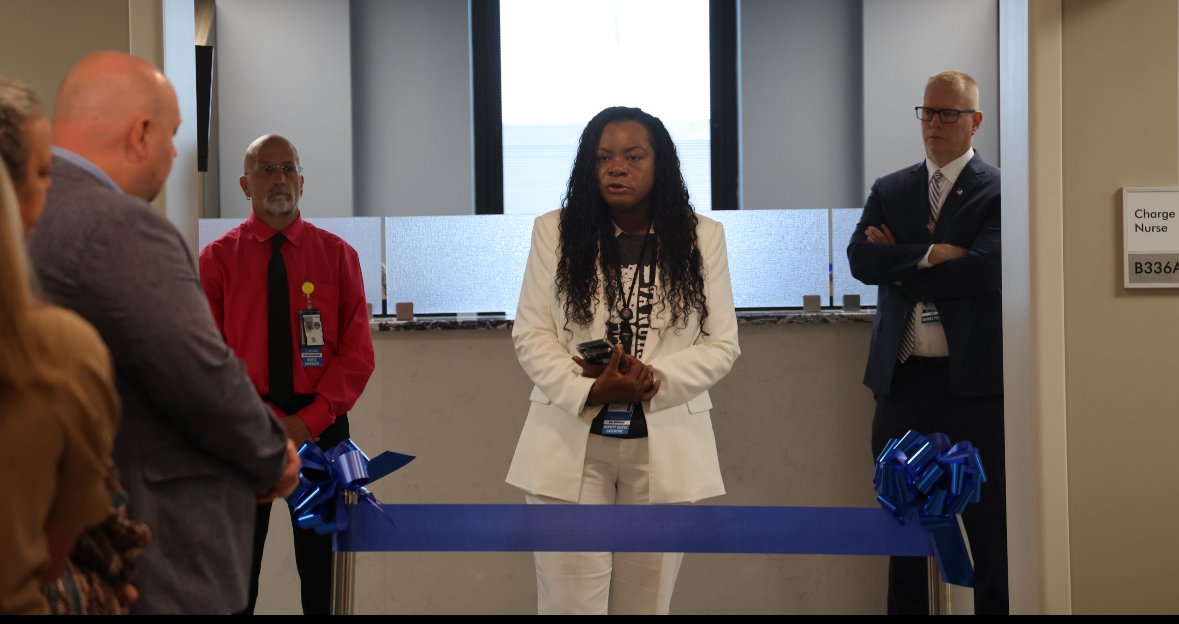
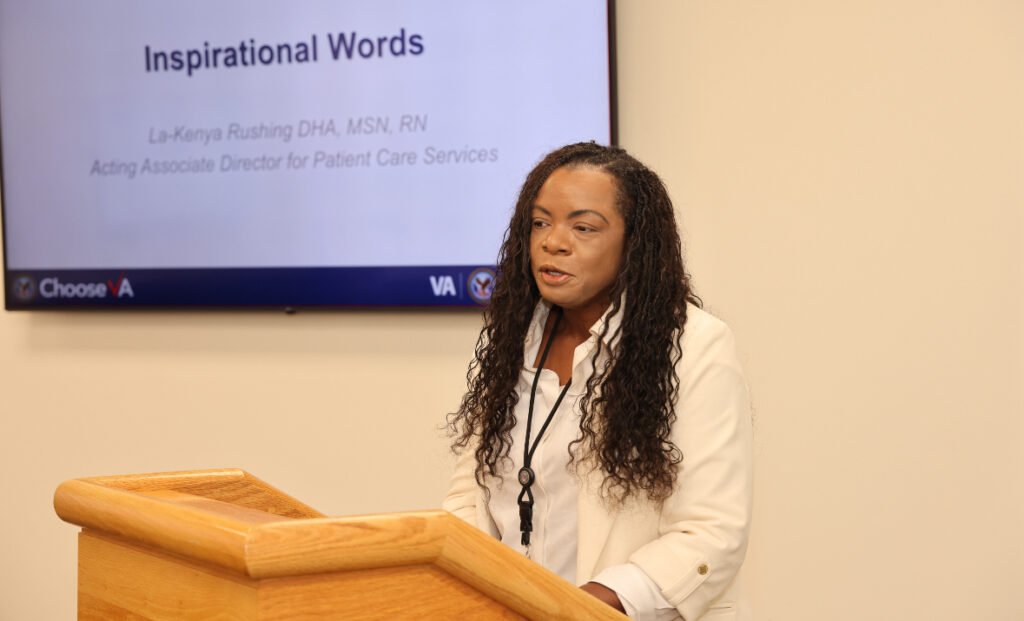
Dr. La-Kenya Rushing’s story is one of service, resilience, and heart. From long nights during the pandemic to leading thousands of nurses across VA Tennessee Valley Healthcare System, she continues to ask the question that changes everything: What matters most?
Dr. La-Kenya Rushing remembers the vaccine that almost went to waste. It was somewhere around 9 p.m., months into the pandemic, and she’d been at work since 6 a.m. Again. Southeast Louisiana Veterans Health Care System had just received shipments of COVID-19 vaccines, and the directive was clear: no waste. Not a single dose could be thrown away. “We had to find arms for vaccine administration without waste, without fail,” she recalls. “And just coordinating processes that didn’t exist before within our facility.”
She was living five minutes from VA at the time, but “living” might be too strong a word. She existed in two places: work and a house she barely saw. Her family started calling her “Miss VA” because whenever they reached out, she was either at the office or thinking about it. That night, like so many others during those early pandemic months, she stayed until they’d found someone for every dose. The vaccine didn’t go to waste. But something else did: time with her own family, sleep, any pretense that health care leadership looked like a 9-to-5 job.
Twenty-five years into her nursing career at that point, Dr. Rushing had learned something crucial: crisis doesn’t announce itself politely. It just shows up and demands you make decisions faster than you’re ready for. “Any pandemic can really take you by storm,” she says. “It’s a time when you have to make crucial decisions really fast.” The decisions she made during those impossible months – identifying 100 nurses to upskill from ambulatory to acute care, building an outdoor testing center from nothing, creating communication systems for families creating communication systems for families who had limited hours to visit their relatives – would propel her career forward in ways she never anticipated. But if you ask Dr. Rushing who she is now, after nearly three decades in nursing and a decade in VA leadership, she’ll tell you the same thing she would have said when she started: a nurse. Someone called to serve. The question is how that calling translates when you’re responsible not for one patient but for thousands of staff members caring for thousands of veterans across multiple states.
The Louisiana Foundation
Dr. Rushing is from the New Orleans area, where family and food and faith all matter in equal measure. Her father is a Vietnam veteran. Both her sisters work in VA. Service to veterans isn’t abstract in her family – it’s personal, it’s expected, it’s who they are. She didn’t plan to become a health care executive. Like most nurses, she started at the bedside, learning what it really means to care for someone who’s hurting, scared, or alone. Thirty years and countless specialties later, she’s accumulated the kind of wisdom that only comes from actually doing the work.
In 2014, she joined VA as a Home Telehealth Care Coordinator – the perfect entry point, she says, because it meant daily interactions with veterans and their families. Patients would use devices to monitor vital signs. She’d retrieve the information, coach them on improving their health, help them set goals. “I learned a lot from veterans and their families about connecting them to resources, listening to them, and helping to coordinate their care,” she explains. But she also learned something unexpected about what made veteran health care different from everything she’d done in the private sector. “Many of them had behavioral diagnoses in addition to medical needs,” she says. “To listen to them and assist them, especially with managing stress and preventing suicidal ideation or tendencies – that really made the population different. I encountered that more in the six months I was there than I had in the span of my career at that point.” That realization – that veterans carry wounds you can’t always see on a chart – would shape everything that followed.
The Crossroads
When COVID hit, Dr. Rushing was a section chief in New Orleans. Southeast Louisiana Veterans Health Care System identified the first veteran officially diagnosed with COVID-19. What happened next would define not just her career but her understanding of what leadership actually requires. “It was a crossroad,” she says. “It was a major crossroad for me.” She was tasked with something that didn’t exist: developing an outdoor testing center, upskilling 100 ambulatory care nurses to work in acute settings, creating systems for families to communicate with patients they couldn’t visit, documenting vaccines in systems that had never been used that way before. The private hospital across the street ended up adopting the blueprint her team created. That’s how new it all was – they were writing the playbook as they went.
But the hardest part wasn’t the logistics. It was the staffing. “We didn’t have a cavalry of nurses that we could call quickly to replace those that were affected by COVID – either they were COVID positive or they had family members,” she recalls. “Not having that cavalry, you have to learn how to use your resources and how to motivate people to do things they haven’t done before and they’re not comfortable with.” She had to ask people to step outside everything they knew, everything they’d trained for, and trust that she’d support them through it. And she had to do it while managing her own fear, her own exhaustion, her own family’s needs.
“During that period of time, I lived within the VA,” she says. Coming in at 6 a.m., leaving at 9 or 10 p.m., making sure every vaccine found an arm, every system worked, every gap got filled. What she learned during those months goes beyond crisis management. “Crisis will occur,” she says. “You just don’t know when it will show up and oftentimes what the impact will be. And just how to lead with positivity. I think that was the task.” Lead with positivity when people are dying. When your staff is exhausted and terrified. When families are screaming because they can’t hold their loved one’s hand. When the systems you need don’t exist yet and you have to build them by tomorrow morning. That’s the task.”
Three Systems, One Truth
Dr. Rushing has now worked across three VA systems: Southeast Louisiana, Gulf Coast, and Tennessee Valley. Different cultures, different challenges, different rates of growth. But one thing remains constant. “All three facilities that I worked in, the mission is the same,” she says. “To provide the best health care, world-class care to our veterans. That’s the thread. That’s the common thread.”
The differences matter, though. Tennessee Valley surprised her with its growth – outpacing even Gulf Coast, one of the fastest-growing VA systems in the country. Managing care across multiple states, with different managers at different sites, requires something beyond standard protocols. “For nursing, it’s making sure that we have standard work, a standard approach to work, and the variations that we have, they’re not vastly different,” she explains. The solution sounds simple: travel to the sites, include everyone in huddles and discussions, standardize without homogenizing. In practice, it means Dr. Rushing and her team are constantly on the road, constantly checking in, constantly ensuring that a veteran in Tennessee gets the same quality of care as one in southern Kentucky or northwestern Georgia.
The Question That Changes Everything
There’s a shift happening at VA Tennessee Valley Healthcare System, one that might sound small but changes everything. Instead of asking veterans “What’s the matter with you?” they’re asking “What matters to you?” “That helps the provider and the nurse better understand how I can deliver that care to you,” Dr. Rushing explains. “It’s the difference between treating a diagnosis and treating a person. Between following a protocol and tailoring care to what this specific veteran needs, wants, can actually do when they leave the appointment.”
For Dr. Rushing, this shift connects directly to her core values as a nurse leader. When I ask her about the values that guide patient-centered care at TVHS, she doesn’t hesitate. “My favorite is integrity,” she says. “Because it’s a foundational and fundamental value that guides our patient care. It involves being honest and fair with everyone. As a nursing leader, when you model integrity behavior, I think that it instills and develops more trust among your teams.” Critical thinking matters too – health care is complex, issues will occur, and teams need to analyze problems together rather than defaulting to established patterns that might not serve current needs. And excellence. Always excellence. “I think it’s pivotal to making sure that we provide the highest standards of care and that we strive for continuous improvement,” she says. “We’re never satisfied. We’re always re-establishing where that bar is. There’s no ceiling for us.”
Building Horizontal Leadership
Ask Dr. Rushing how she inspires and supports nursing teams in a demanding care environment, and she talks about something that cuts against traditional health care hierarchy. “My focus is on advancing values of a highly reliable organization,” she says. “We focus a lot on resiliency and proactive patient-centered care. I think it’s important to model open communication and collaborative communication.” Recently, TVHS leveraged shared governance councils through nursing. “Decisions aren’t vertical, they are horizontal,” Dr. Rushing explains. “We can include nurses in making decisions about how to provide the best care and to use evidence-based practice to really fortify what we do.”
It’s a radical idea, really – that the people actually doing the work should have a say in how that work gets structured. That frontline nurses might know something about patient care that executives in conference rooms don’t. But Dr. Rushing learned the value of this approach decades ago, back when she was the frontline nurse, back when she wished someone would ask her opinion about workflows that affected her patients. She also learned something about keeping staff engaged that goes beyond policy changes. “We prioritize engagement, intentional rounding,” she says. “The deputy chief, the deputy chief of staff, the chief of staff, or any member of the executive leadership team or nursing leadership team – we intentionally round together. We intentionally put ourselves in forums where people can see us working together through complex decision making.” And when there’s disagreement? “We can navigate and negotiate how to come to a shared decision that works for everyone.” Staff need to see leadership modeling the behavior they’re asking for. They need to see executives working through conflict with respect and arriving at solutions collaboratively. They need to know that disagreement doesn’t mean failure and that the best answer might come from the newest nurse on the team.
Measuring What Actually Matters
Dr. Rushing manages thousands of clinical staff. The metrics could easily become the mission – hit the numbers, meet the targets, check the boxes. But she’s focused on something different. “At TVHS, we work diligently to assist nurses with connecting their provision of care – what they do – with what the patient’s outcomes are and how they influence patient outcomes,” she explains. They prioritize nursing-sensitive indicators: metrics that measure outcomes directly influenced by nursing care, like fall prevention.
Here’s where theory becomes practice. They provided nurses with direct training on preventing falls. They provided equipment. And they purchased technology to serve as a virtual sitter. The result? Falls reduced by 30% in less than a year. That’s not a number on a spreadsheet. That’s 30% fewer veterans experiencing the trauma of a fall, the complications that follow, the extended hospital stays, the loss of confidence and independence. “That’s our goal,” Dr. Rushing says simply.
The Scholar in Scrubs
Somewhere in the middle of building her administrative career, responding to a pandemic, and traveling between three VA systems, Dr. Rushing went back to school. And then back again. Master of Science in Nursing. Doctorate in Health Care Administration from Virginia University-Lynchburg. Memberships in the American Association of Healthcare Administrative Management, Sigma Theta Tau International Honor Society, the American Nurses Association, the Louisiana State Nurses Association. She stays connected to the broader nursing community. Keeps learning. Keeps growing. Because after 30 years, she knows something crucial: there’s no way to know everything, but you can aspire to learn as much as you can retain. The moment you think you’ve learned it all is the moment you become irrelevant to the students and emerging leaders who will take your place someday.
What Tennessee Valley Taught Her
Before joining VA Tennessee Valley Healthcare System full time, Dr. Rushing completed a 4-month rotation there in 2023. The experience left a lasting impression. She returned in June 2024 as Deputy Associate Director for Patient Care Services in Nashville, and by May 2025, she had been named Acting Associate Director for Patient Care Services for the entire system.
When I ask her about her favorite facility among the three, she has worked in, she doesn’t hesitate. “By far Tennessee Valley is my favorite,” she says. “I work with a team of committed consummate professionals, and we share in our decision making. We’re always in the mindset of how we provide more to our veterans?” Her voice grows firmer. “Regardless of what’s going on, we’re focused. We’re focused on veteran-centric care, patient care, and outcomes. It’s not really about metrics. Our heart and our skin is in this, just to make sure that we get people what they deserve, our veterans what they deserve, and their families.”
Not metrics. Hearts and skin in the game. That’s what excellence looks like when you remember it’s about people, not performance reviews.
The Balance She’s Still Learning
For all her dedication to work – and the “Miss VA” nickname is well-earned – Dr. Rushing knows something that took her years to learn. “I think I’m more balanced than I’ve ever been,” she says. “Over time you learn that if you burn out, you don’t have anything to give. I’ve learned over the years to balance work with life and to actually encourage others to do the same.” Even if she’s not perfect at it yet, she recognizes burnout symptoms in others after three decades of nursing. “Sometimes you have to stop and say, hey, you know what, you need to model this as well. Take care of you.”
She has a daughter. A grandson who brings her joy. And hopes that one day, he might choose medicine, might choose VA, might continue the legacy her father started as a Vietnam veteran and her family has carried forward through her and her two sisters. “I’m hopeful that someday my grandson chooses medicine and he chooses VA to continue my legacy,” she says. “In any field that he chooses that touches VA or health care, that would make me proud. Extremely proud.” But more than that, she hopes anyone who interacts with her sees how much she cares about taking care of veterans and keeping them well. “I hope that they in some way or another are influenced to choose VA,” she says.
What Veteran Excellence Actually Means
When I ask Dr. Rushing to define veteran excellence from a nursing leadership perspective, she pauses to consider the question carefully. “From a direct standpoint, I think veteran excellence is when the patient experience aligns positively with the quality of the outcome,” she says. “At TVHS, we strive for the highest provision of quality, and we commit to continuous improvements.” Then she adds something crucial. “We’re never satisfied. We’re always re-establishing where that bar is. There’s no ceiling for us. We want to be the absolute best at fostering timely access to well-coordinated, world-class health care.” No ceiling. That’s the mindset. Not “good enough for government work.” Not “we did our best with limited resources.” Not “compared to other systems, we’re doing fine.” The absolute best. World-class. Nothing less.
What Gives Her Hope
After 30 years in nursing and nearly a decade in VA leadership, Dr. Rushing could be forgiven for feeling burned out, cynical, exhausted by bureaucracy and staffing shortages and the endless challenges of health care leadership. But ask her what gives her hope, and she lights up. “Our fourth mission in VA is education, and what gives me so much hope is the students and, outside of the students, the emerging leaders,” she says. “I see myself in a lot of people in a lot of different ways. I’ve worked in so many specialties in nursing, and I remember what it was like to be a student.”
When students from the community rotate through TVHS, she sees that twinkle in their eyes. Their curiosity. Their inquiry about evidence-based practice, about how to make things better. “I learn from them because things have changed over 30 years,” she explains. “And even from this season, there’s no way you can know everything. But I aspire to learn as much as I can retain. That’s what makes me hopeful – the future generations of nurses.” She’s also grateful for those retiring, exiting nursing, because she knows she’ll have to prepare herself mentally to be in a different place in her life someday. But for now, the students give her hope. The emerging leaders give her hope. The possibility that someone watching her lead might decide to follow in her footsteps – that gives her hope.
The Crossroads of Nursing
Near the end of our conversation, I ask Dr. Rushing what she wishes more people understood about her role and her team. She brings up something crucial, something that extends far beyond VA Tennessee Valley Healthcare System. “Nursing is really at a crossroads,” she says. “COVID is one of those things that really demonstrated that. For nurse executives, it’s a crossroads where we’re challenged with motivating nurses to provide excellent care while confronting the reality that currently and in the future, we’re going to have some really horrific nursing workforce shortages. The gap is growing.” It’s a crisis that keeps her up at night. How do you recruit and retain excellent nurses when the work is demanding, the pay often isn’t competitive, and burnout is rampant across the profession?
At Tennessee Valley, they’ve found some answers. “Fortunately, TVHS, we have a very strong nursing leadership team and support from our executive leadership team members,” she says. “And because we work so hard to recruit and retain the best talent, we have one of the lowest vacancy rates in our VISN [Veterans Integrated Service Network]. We’re at less than 6%.” She’s quick to add context. “When we’re compared to other 1A-complexity facilities, we’re amongst the lowest.” Her voice gets firm. “We’re resilient. We do what we can with the resources that we currently have, and we work diligently to make sure that we prioritize and appropriately allocate what’s required to make sure that we don’t compromise care.” Don’t compromise care. That’s the line. No matter what else happens – staffing shortages, budget constraints, administrative burdens – they will not compromise care.
The Legacy She’s Building
Dr. Rushing also mentions something else she wishes people understood: the importance of representation. “I think it’s important for emerging leaders and patients to see representation of people of different ethnicities who are motivated to provide them with the best resources and provision of care,” she says. She doesn’t elaborate beyond that, but the point is clear. When patients see providers who look like them, who understand their experiences and communities and challenges, something shifts. Trust builds. Communication improves. Care gets better. And when emerging nurses and leaders see someone like Dr. Rushing – a Black woman leading patient care services across multiple states, making decisions that affect thousands of veterans and staff members, modeling integrity and excellence and collaborative leadership – they can imagine themselves in those roles. Representation isn’t just about diversity metrics. It’s about possibility.
The Work Continues
For Dr. La-Kenya Rushing, the next chapter isn’t about climbing higher or achieving more accolades or building a bigger resume. It’s about the question Tennessee Valley is teaching veterans and staff members to ask: What matters to you? For her, what matters is seeing nurses connect their daily work to patient outcomes. It’s reducing falls by 30%. It’s making sure every veteran gets care tailored to their needs, not just their diagnosis. It’s building horizontal leadership where the best ideas can come from anywhere. It inspires students and emerging leaders to choose this work, this calling, this mission.
It’s staying at work until 10 p.m. to make sure not a single vaccine dose goes to waste, because that dose represents someone’s parent or grandparent or spouse who deserves protection. It’s being “Miss VA” not because she can’t separate herself from work, but because the work matters enough that she’s willing to sacrifice for it – and then model work-life balance so her team doesn’t have to make the same sacrifices she did. For the veterans receiving care at VA Tennessee Valley Healthcare System, having Dr. Rushing in leadership means something concrete: someone who remembers what it’s like to be at the bedside, who values people above processes, who brings both the heart of a caregiver and the mind of an administrator to every decision.
Health care leadership can feel disconnected from the realities of patient care. But Dr. Rushing represents something different – a leader who remembers where she came from and never lost sight of why this work matters. That’s her greatest strength. And maybe, in the end, that’s the definition of veteran excellence: when the patient experience aligns positively with the quality of the outcome, and when the people providing that care know that their work matters, that they matter, that excellence isn’t just possible but expected.
Dr. Rushing is from New Orleans, where they know something about building solid foundations, about weathering storms, about coming back stronger than before. She’s brought all of that with her – the resilience, the positivity through crisis, the unshakeable commitment to the mission – and she’s building something that will outlast her tenure, her career, her lifetime. A legacy of nurses who ask the right questions. Who lead with integrity. Who never compromises care. Who knows that after everything else is stripped away, they’re still just nurses. People called to serve. And who answers that call every single day.
Resources for Veterans & Healthcare Professionals
VA Healthcare & Patient Care Services
- VA Health Care Enrollment: How To Apply For VA Health Care | Veterans Affairs
- My HealtheVet: Home – My HealtheVet – My HealtheVet – Manage VA healthcare, prescriptions, and appointments
- Veterans Crisis Line: Dial 988, then press 1 | Text 838255 | Veterans Crisis Line
Mental Health & Wellness Support
- Vet Centers: Find VA Locations | Veterans Affairs – Community-based counseling and readjustment support
- National Center for PTSD: PTSD: National Center for PTSD Home
- Give an Hour: Find Mental Health Services, Resources, and Education – Give an Hour – Free mental health services for veterans and families
Nursing Leadership & Professional Development
- American Nurses Association: American Nurses Enterprise | American Nurses Association
- Sigma Theta Tau International Honor Society: Sigma Home Page
- American Association of Healthcare Administrative Management: American Association of Healthcare Administrative Management
- Louisiana State Nurses Association: https://lsna.org/
VA Careers & Employment
- VA Careers: Careers at VA – U.S. Department of Veterans Affairs
- VHA Office of Nursing Services: Office of Nursing Services (ONS) Home
Support for Military Families
- Military OneSource: Support for Military Personnel & Families | Military OneSource | 800-342-9647
Connect with VA Tennessee Valley Healthcare System
- VA Tennessee Valley Healthcare System: VA Tennessee Valley Health Care | Veterans Affairs
- Patient Advocates available at all TVHS facilities
About Dr. La-Kenya Rushing
Dr. La-Kenya Rushing holds a Doctorate in Health Care Administration from Virginia University-Lynchburg and a Master of Science in Nursing. She has nearly 30 years of nursing experience and has been serving veterans through the Veterans Health Administration since 2014.
Veteran Excellence Magazine celebrates outstanding leadership in veteran healthcare and services.