
Summary
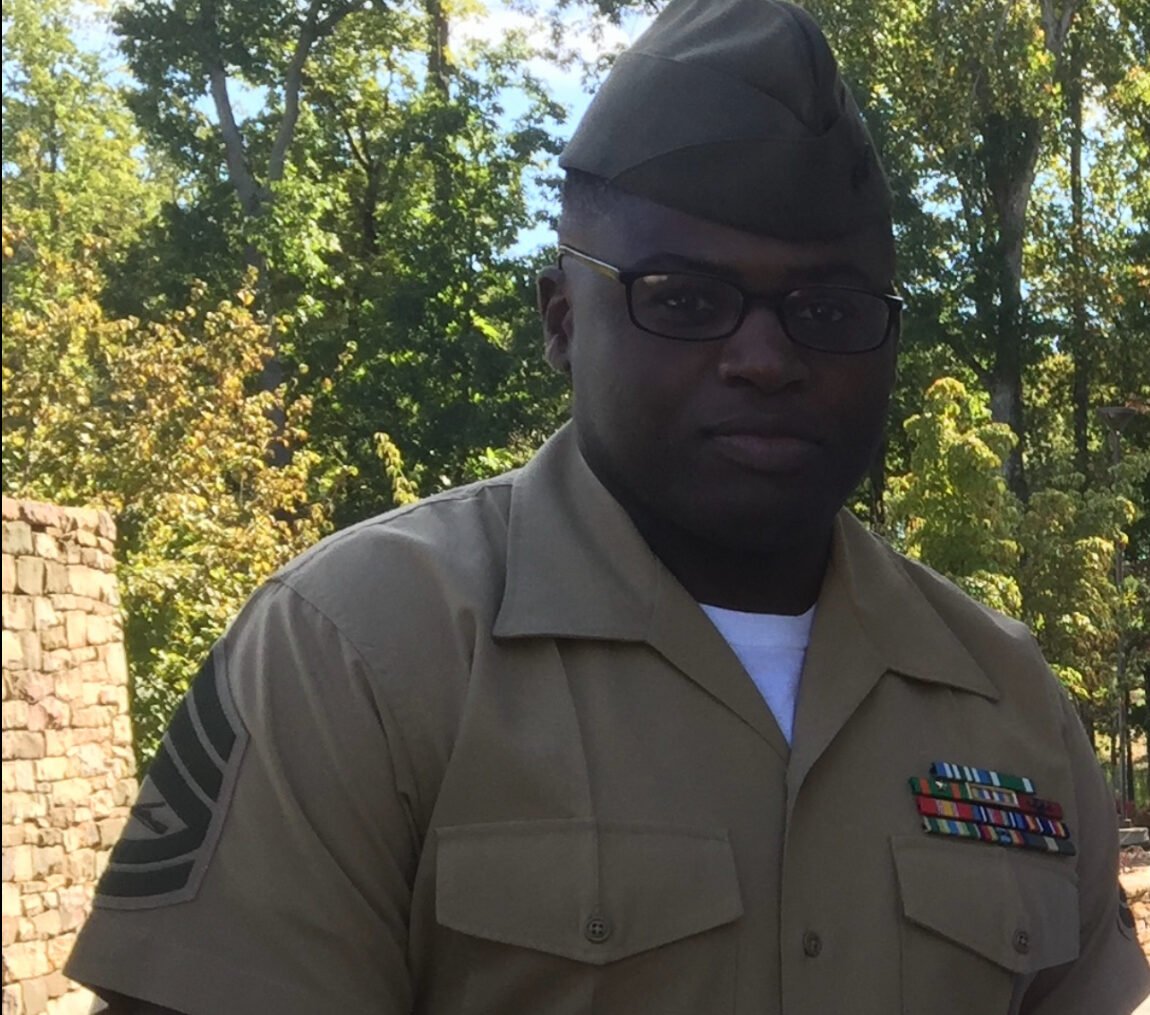
Marine Corps veteran Leroy Brown never stopped drawing – not through deployments to Japan, the Middle East, the Philippines – not through 20 years of service. Now retired in Virginia, he is pursuing the artistic career he dreamed of as a child in Natchez, Mississippi. His work blends folk art traditions with bold colors and exaggerated movement, telling stories of urban church life, cultural memory, and the communities that shaped him.
In Leroy Brown’s studio hangs a certificate from 1992 and 1995. Fourth grade. Special recognition for art. Seventh grade. Most Improved-Art. He was ten years old in Natchez, Mississippi, already certain about one thing: he was a creator.
“I found myself drawing on everything. Even as an honor roll student, it was one of the subjects that I excelled at most. I didn’t have any painting experience to speak of, but I was a creator from the start.”
Those certificates are still framed. Thirty-three years later, it reminds Brown of something essential about himself – something that survived boot camp at age nineteen, two decades in the Marine Corps, deployments across multiple continents, and the practical realities of supporting a family. The kid who drew in the margins never disappeared. He just learned discipline.
Getting Out of Mississippi
Brown grew up in Natchez without seeing anyone who looked like him making art professionally. His seventh-grade art teacher was the first real artist he encountered, but even then, representation was missing.
“I didn’t see any African American artists. I wasn’t mature enough or well-versed enough to know they existed. So, when I kept drawing, I found myself observing more as I got older. But I wanted to go to school for art, and when I got close to twelfth grade, I didn’t think it was realistic.”
His parents hadn’t gone to college. He didn’t see a clear path. What he did see was a way out of Mississippi that came with structure, benefits, and the kind of clarity he needed when he was young and undecided about everything except that he wanted to create.
“The military took me out of there. After one semester of college in Mississippi, I realized I didn’t want to be there anymore. I didn’t want to live at my mom’s house. I was undecided about what I wanted to do – graphic arts, animation, cartoons. I didn’t have a scholarship. I didn’t want my mom to try to pay for me to go to college, and I didn’t have enough knowledge about grants. So, I went into the Marine Corps. And I never stopped drawing.”
He swore in in October 2000, on his nineteenth birthday and enlisted in December 2000. He’d be gone for twenty years.
Boot Camp and Confidence
Recruit training at Marine Corps Recruit Depot San Diego changed everything about how Brown understood challenge and what he was capable of accomplishing.
“You go there, they tell you how to change, what hand to use when you’re shaving, what foot you start marching with. Everything is regimented. But being broken down for three months, being away from Mississippi in California for the first time – there were a lot of firsts for me. I’d never really been challenged like that before.”
The physical demands were one thing. But being dropped into an environment with people from everywhere – different parts of the country, different backgrounds, different life experiences – expanded his worldview in ways Natchez never could. It gave him something else he didn’t expect – confidence. Not manufactured bravado, but the earned kind that comes from doing hard things you weren’t sure you could do.
“It gave me confidence. I was already born confident, but when I came into the Marine Corps, it gave me something I had never experienced before. The Marines stay the same wherever you go, but you meet different people. And you still represent where you’re from.”
Brown’s MOS was administrative – personnel work, anything clerical in nature. He knows that’s not what most people picture when they think about military service.
“Everybody thinks military is always deployed, always going into war. That wasn’t me. My family would always say, ‘You mean you get to have time off on weekends?’ Yeah. You have different responsibilities based on what you signed up to do and work specifics differ. I signed up for a clerical MOS.”
He just knew that he would deploy after September 11. He was stationed in Japan, then South Carolina, but he was never attached to a unit heading to Iraq.
Keeping Art Alive in Uniform
Throughout his Marine Corps career, Brown kept drawing and painting – in the barracks over in Japan, in South Carolina, everywhere he was stationed. He found the art communities and immersed himself in those atmospheres. But it was hobby work, the kind of thing you do because you love it, not because you’re building a career.
That changed eight years into his service when he met his mentor.
“His name is Hank Herring. He’s a historian, a framer, and an artist. He inspired me to frame myself as an artist. He made me think of it as more than just something I did. Meeting him – someone who looked like me, who had the same background as a Marine Corps veteran, who was also African American and making it as an artist – that made me take art seriously as a business.”
Herring is much older than Brown. He’d already retired from the Marines and was working as a professional framer/artist when they connected. Watching someone just ahead of him on the same path showed Brown what was possible.
“I always say my mentor doesn’t have to be alive. But Hank happens to be alive, and he’s the one I’ve been learning from since the first half of my Marine Corps career. That’s when I started conducting myself as an artist. 2008 was when switched to another gear from a business perspective.”
Folk Art, Movement, and Memory
Brown’s work is immediately recognizable. Vivid colors. Exaggerated forms. Movement that feels like you’re watching people mid-gesture, mid-conversation, mid-worship. He calls it folk art rooted in his Baptist upbringing and the Black church traditions he grew up around.
“For me, it comes from my lived experience. I paint what I see, what I have seen, and what I want to see. I paint things that I think about. I grew up Baptist. I grew up around music and motherly women in the church. My artwork is a true representation of those elements.”

A great number of his paintings aren’t realistic. That’s intentional. He wants viewers to use their imagination, to see themselves in the work rather than a specific, identifiable person.
“Someone at an event asked me, ‘Why don’t you paint faces with detail?’ Well, I want you to use your imagination. I don’t want to put anybody specific there. It’s not always about the expression on the face. It’s about the movement that you see. I’m exaggerating the form, exaggerating the leg. It’s telling you a story.”
A woman once told Brown she’d seen his work at another business and felt immediately drawn to it. She said she’d never seen anything that moved her like that before. That moment crystallized something for him about what his art accomplishes.
“That’s what keeps me going. This woman’s heart was being moved. Not necessarily by a specific person in the painting, but by what she saw. Maybe she saw someone in a pink dress, and she could make it whoever she wanted it to be. That’s the element of abstraction that I love. I grew up around Black churches, around grandmothers and aunties, around Black excellence. I didn’t even know it was Black excellence then because they just revered the culture.”
Influences: From Picasso to Hank Herring
Brown cites Pablo Picasso as a major influence, specifically Picasso’s approach to abstraction and his philosophy about creativity.
“I realized everything doesn’t have to be realistic. Everything doesn’t have to be sophisticated. I like that about Picasso. He said, ‘Everything you can imagine is real.’ That’s one of the quotes I live by.”
He also took to heart Picasso’s statement about artistic theft: “Good artists copy. Great artists steal.” Brown interprets this not as plagiarism but as the creative tradition of building on what came before.
“Michelangelo was looking at something and getting inspiration. Even from the cave paintings, the hieroglyphics from Egyptian times, they were looking at something and building on it. So, we shouldn’t get wrapped around the axle about ‘Oh my God, I did this art and someone else did something similar.’ You’re not the only person out here who’s had this idea. You just have to keep doing your work.”
But his primary mentor remains Hank Herring- the Marine who showed him that someone with their shared background could make it as a professional artist.
“My mentor is somebody like me. Somebody with the same background in the Marine Corps. Somebody African American who’s made it, who conducts himself professionally. It’s unbelievable to see him operating and just being. I hope that other people see that about me. I can do this all day. I’ve been doing this since elementary school.”
The Commission Process: Going Down Rabbit Holes
When Brown takes on commissioned work, he doesn’t just paint what he sees in a photograph. He researches. He listens. He builds a spiritual connection to the subject.
“If a client wants a picture of their grandmother or someone who’s passed away, I engage with the client. I ask what they’re trying to emphasize. Then I take creative control with a little input. They chose me for my skills, not to copy someone else’s art. I want to give them something unique.”
He asks clients for music that reminds them of the person. Then he spends hours listening while he paints, learning about his subject through sound.
“I literally listen to music as I’m painting. I learn about the person. I’m looking at this person and they’re staring back at me. Sometimes it’s more than one person – two or three people. But I investigate what I’m painting. I might listen to a podcast about them. I go down rabbit holes researching on my own, and it becomes educational for me.”
He did this when he painted Maya Angelou. Spent hours learning about her, listening to her work, absorbing her story. When he finished, a client bought it before he could even decide where to display it.
“My process is from start to finish. I investigate. It becomes an educational piece for me.”
For his own original work – not commissions – he paints from memory. Church scenes. Family gatherings. Moments from his Mississippi childhood.
“I’m going off memory. I’m reliving a scene from a time I was there. In the church with the stained-glass windows, the hand clapping. A picnic. Whatever I’m painting, I’m reliving it.”
Twenty Years, Then What?
Brown retired from the Marine Corps in 2020. He’d given twenty years of his life to military service. The plan was to go full-time with his art.
“When I retired, some of my peers who retiring too, their eyes were on going to the federal government or whatever they were trying to do. They were not done working. Me? I was done working for people. I was done working for the man.”
He had leveraged his peers didn’t. His wife had a stable government career. That gave him room to breathe, to try making it as a full-time artist without the immediate pressure of replacing a military salary.
For four years, Brown lived off savings, his military retirement, and whatever he could earn from his art. He worked at events as a vendor for his product. Built inventory. Invested everything back into the business. He paid his mortgage and funded Leroy Brown Art without taking another job.
“Think about it – for four years, I could have earned anywhere between $80,000 to $100,000 a year that I went without, just because I wanted to do art and go to school.”
He was getting his bachelor’s degree during this time, painting full-time, building his brand. Due to the never-ending roller coaster of an entrepreneurial journey, Brown knew that there was more out there to put inside his toolbox.
Rory, his friend and fellow boot camp brother came to visit his studio. Rory looked around at everything Brown was doing – the painting, the business development, the brand building – and asked a simple question: “Why don’t you work for the government, you’re never gonna stop being an artist?”
Brown’s wife had been saying the same thing since the day he retired. The practical argument was straightforward: most of what he was doing as an artist required the same skills he’d use in an office job. Why not do both?
“Rory told me, ‘Most of the stuff you’re doing as an artist, you should be doing in government.’ So, I started applying for jobs. I got hired and started working last December as a budget analyst. I’m telling you, I forgot what it felt like to get paid every 14 days.”
It’s the same discipline Brown learned in the Marines applied to a different problem. You don’t have to choose between financial stability and creative work. You can structure your life to support both.
The 3 AM Writing Routine
Brown’s creative schedule sounds like military training. He wakes between 3 and 4 AM and writes
“That’s straight from the Marine Corps. The military gave me that discipline.”
He’s working on a book right now. Actually, multiple books. A graphic novel about his artistic journey. A guide for young artists and entrepreneurs. He’s been blogging since 2018, building content he can pull from when he’s ready to put the books together.
He’s also planning a solo art show around his 45th birthday – October 24, which happens to be one day before Picasso was born but a hundred years earlier in 1881. The show will be called “Out of Sight, Out of Mind” – a play on his last name, Brown, and the way abstract art works.
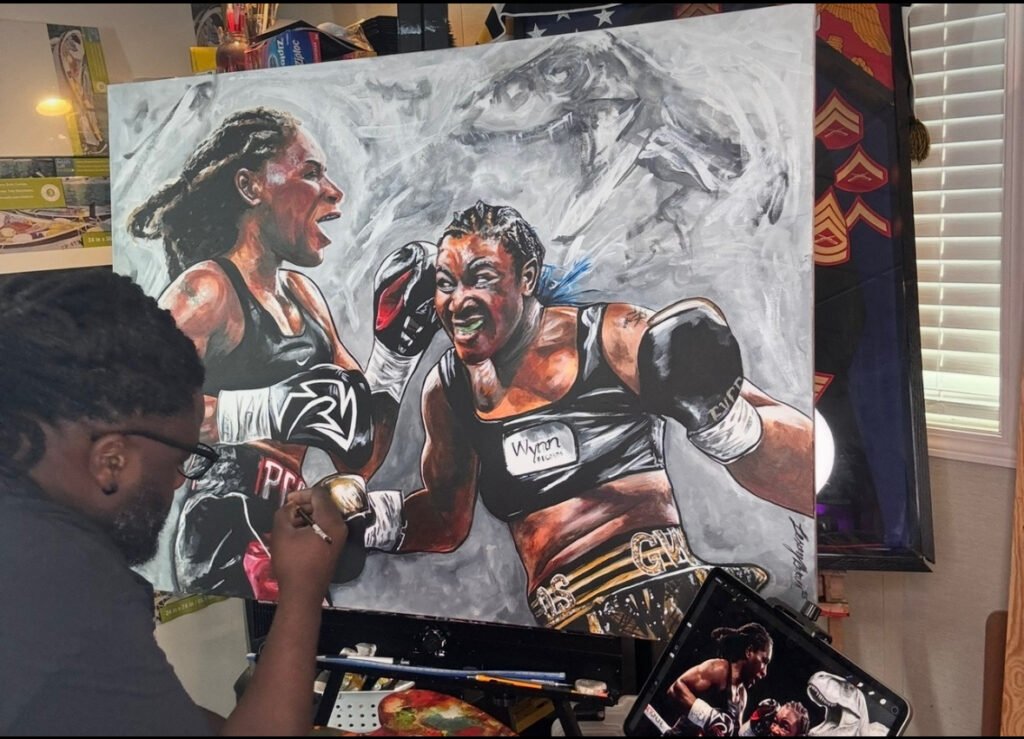
“Out of sight, out of mind. Out the sight of Leroy Brown, Out of the mind of Leroy Brown. How’s that for abstract context?”
Building a Brand That Outlasts You
Brown thinks about legacy constantly. Not in an abstract way, but practically. He’s building something that can outlast him, something his ten-year-old daughter Kennedy can inherit if she desires.
“I have three kids. My oldest is about to be 23 in February. I have one that’s about to be 21 in December. And I have a 10-year-old. She’s watching all of this creativity and business.”
Kennedy has her own hashtag already: Kennedy Brown Art. Her father has been teaching her about the business side of art, driving her to events, showing her how to set up displays, talking to her about branding.
“I feel like I’ve been developing her brand while I’ve been developing my brand. When it’s time for her – she has eight years before she graduates high school – she can figure out what she wants to do. But if she wants to approach art, she’ll have a foundation. I started her hashtag so nobody else has it.”
His two older children aren’t artists. His son got into music production for a while and is currently a college student. His oldest is in her senior year of college. They’re watching what their father built, even if they’re not following the same path.
“I think with the kids, my oldest two will benefit from the business. But they’re not the artists. It’s my youngest that I’m really teaching. I think it’ll be a great opportunity for her. My legacy goes past me. I want to be like the Picassos of the world, where somebody can look back when I’m away from here – not dead, just away – and say this person lived a real life.”
He puts two fingers up when he says that. Peace sign. Not goodbye forever. Just see you later.
What Brown Wants Young Veterans to Know
Brown has advice for veterans with creative passions who aren’t sure if they can pursue them seriously. It’s the same advice he’d give to anyone, but it hits different coming from someone who gave twenty years to the Marines.
“You have the same 24 hours everybody else has. Think about it – if you work eight hours a day, and you sleep eight hours, what are you doing with the remaining eight hours? You’ve already worked or gone to school. There’s eight more hours in a day. What are you doing with that time?”
Multiply those eight hours by seven days a week. Then by 12 months. That’s a lot of time you’re either using or wasting.
“You’re gonna make time for somebody else’s dream. Nothing wrong with that – we all need jobs. But who are you making time for? What are you getting better at? If you want to do something, you have to get past the obstacle of not doing it. That’s the biggest problem. You just gotta start.”
He’s direct about this because he lived it. The Marines taught him how to show up consistently. Now he applies that to art.
“I gave 20 years of passion to the Marine Corps and this country. I was passionate about service. Why wouldn’t I be more passionate about my art? I’ve always been passionate about it. I never let it go. I never lost who I was throughout the process of becoming a Marine, maintaining standards, being a Marine. People said they’d never seen a Marine like me. I was different, but I was me.”
Prophetically Producing Profound Pictures, Promoting Peace, Power, and Prosperity
Brown’s tagline is “Prophetically producing profound pictures, promoting peace, power, and prosperity.” It’s alliterative and catchy, but it also means something specific to him about what art does.
“I think my art tells a story where you can be delivered from whatever you’re going through or whatever you want. Peace of mind.”
Power, in his framework, comes from impact. A painting moves someone. A blank canvas becomes something that makes people feel a certain way. That’s transformation through creativity.
Prosperity isn’t just financial. It’s about growth, presence, being witnessed doing what you were meant to do. It’s someone calling out of nowhere saying they need a painting. It’s being nominated for awards. It’s building a brand that people recognize – the way they recognize Bounty paper towels or Tommy Hilfiger or any other name that became synonymous with something.
“My last name is Brown. My first and last name, I put on my art. I want people all over the world to know that brand. I don’t want to die before people recognize my work. I want to be here and present.”
Culture, Community, and Being Called Back
Brown was nominated this year for Culture Catalyst Black Brilliance Award by the Virginia Black Chamber of Commerce. He didn’t even know what the award was until someone told him he’d been nominated.
“Regardless of whether I win or not, being nominated means someone said, ‘He is a culture catalyst. This person’s image represents the culture.’ My image is everything about the culture. I’m exhibiting that culture in my artwork. I’m not ashamed. I’m not trying to hide anything. I’m telling my story.”

He’s been to middle schools and high schools in the local area talking to students. Seventh and eighth graders. Kids the same age he was when he first knew he wanted to make art but didn’t see anyone who looked like him doing it professionally.
“I want to be that community resource. When something comes up, call me. I’m here. Even if they don’t ask, I’m here. I want to be regular, accessible. I go out of state too, but I always come back.”
That’s what matters to Brown now – being present. Being visible. Being who he needed to see when he was ten years old in Natchez with a fourth-grade art certificate and no roadmap.
The Marine Corps taught him discipline. Twenty years of service taught him how to show up. Mississippi gave him the culture and memory that fuels his work. And now, at 44, working as a budget analyst by day and painting at 3 AM, Leroy Brown is building something that will outlast him.
He’s still that kid who drew on everything. He just learned how to turn it into a brand all out of his sight and out of his mind
Resources
Leroy Brown’s Work
- Website: Original Artwork – Leroy Brown Art
- Instagram: leroy_brown_art
Veteran Arts Organizations
National Veterans Art Museum – Dedicated to the collection and exhibition of art created by veterans from all periods of conflict. Visit: National Veterans Art Museum
Veterans in Media & Entertainment – Helps veterans transition into careers in the entertainment industry. Visit: Veterans in Media & Entertainment
CreatiVets – Provides songwriting and music therapy programs for veterans dealing with trauma, PTSD, and traumatic brain injury. Visit: Empower Veterans Through Arts – CreatiVets
Mental Health & Transition Support
Veterans Crisis Line – 24/7 help for veterans in crisis. Call or text 988 and press 1, or chat at 988 Lifeline – If you need emotional support, reach out to the national mental health hotline: 988.
Vet Centers – Community-based counseling centers for veterans and families, offering readjustment counseling and support. Call 877-927-8387 or search at Find VA Locations | Veterans Affairs