
Blake Stilwell enlisted in the Air Force right after 9/11 with no clear plan beyond wanting to serve. He ended up in combat camera almost by accident. He was the youngest person in the unit and spent his time trying to prove he belonged. Now he’s the editor of We Are The Mighty, where he tries to quell the two laziest narratives about veterans: that they’re all traumatized victims or superhuman heroes. His actual position? Veterans are just like everybody else – they watch football, love their families, and happen to have served. And that’s the hill he’s willing to die on.
Blake Stilwell joined the Air Force in 2001 for the most honest reason possible: he had no idea what else to do with his life.
“I went in Open General. I think it’s called something else now, but basically, the Air Force picks your job for you. I went in right after 9/11, and I just wanted to join. I didn’t know what I wanted to do with my life, so it was time to serve.”
The Air Force assigned him to Visual Information Production and Documentation – combat camera. It wasn’t a choice. It was what they had available. But Stilwell did very well on the ASVAB, so they could have thrown him anywhere. He’s grateful it landed him there, though it didn’t start out glamorous.
“I didn’t go right to Combat Camera. I went to a base photo lab where I was taking passport photos and learning how to edit video. Basically just kind of figuring it out.”
Then he saw the combat camera guys. They worked across the street at Charleston Air Force Base. They had the cool unit patches. They carried cameras everywhere. Stilwell thought they were the coolest guys he’d ever seen.
When the Air Force decided that someone from their photo lab had to move to Combat Camera, Stilwell volunteered immediately.
“I was like, ‘Please, pick me. I’m happy to do it.’ And no one else wanted to go.”
He ended up being the youngest, lowest-ranking person in the unit at the time. It used to be a special assignment with a competitive package and approval process. Stilwell just got lucky – they moved him over without any of that.
“When you get lucky like that, I don’t like to look a gift horse in the mouth. I tried my best to earn my spot there. Everyone else had to put in a package and go through the approval process, and they just moved me over.”
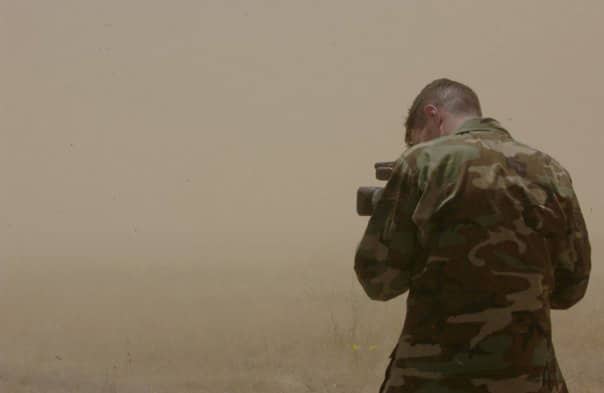
Earning Your Spot When You’re Nineteen
When Stilwell actually started working in Combat Camera, he had something to prove. He wanted to feel like he belonged. More importantly, he wanted everyone else to believe he belonged.
“You do that a long time. I mean, you’re working 60 hours a week just on base. When you deploy with Combat Camera, the hours are even longer. Whatever mission – humanitarian action, training exercise, combat action, whatever – you’re there for however long that takes.”
And when everyone else goes home, the combat camera team still has work to do.
“You have to go home and process the imagery that you shot. You have to caption it. You have to ship it off to the Pentagon or whatever it’s supposed to go. And then when everybody else is going to bed at zero six hundred to rally off at zero eight, you have to be there for everything the next day.”
It’s a lot of hours. It’s exhausting. But Stilwell points out something essential: “It’s a good thing it’s a creative job, because if you weren’t doing something that you loved, I can’t imagine anyone putting in that kind of hours.”
That’s the Combat Camera life. You sit there and do it all day, then get up as early as everybody else the next day. It didn’t take Stilwell long to realize this was what he wanted to do.
“Everybody there had a real passion for it. Everybody there was very creative and had a really good sense of humor. There weren’t many of us in the Air Force who did this job – a couple dozen people throughout the Air Force at the time. So, it was a really neat situation. It was something really unique that we all did, and we bonded over it. And then of course, you’re just a bunch of creatives sitting around being creative. It was a really fantastic environment to come into as a young person. And I can’t see myself doing anything else.”
He was nineteen years old.
The Lesson That Changed Everything
There wasn’t one specific story that changed how Stilwell saw his role. But there was one early moment that taught him everything he needed to know about being good at what he does.
“I was brought in to rescue a video that had terrible production value, bad audio, bad video. There was nothing very much good going for it.”
It was a piece about the Tuskegee Airmen, legendary people who did something incredible. Whoever shot this video didn’t care about quality at all. They were documenting people who deserved better.
“If I had been given that assignment, I would have done everything I could to make sure that everything was perfect for those gentlemen. And I didn’t understand how you could come back with something like that.”
But here’s the thing about being in that job: you can’t restore something that wasn’t there in the first place. So, Stilwell did what he could. He made a product that wasn’t a slap in the face to the people being honored.
“You gather some archival footage, you gather some good music, you gather some good sound bites that still work, some good photos. You do some Ken Burns effects. And then you give them something that you hope they like, and that is at least – you put in effort worthy of the effort that they put in.”
That lesson stuck with him. It was 2005. Those guys weren’t going to be around much longer.
This wasn’t a discovery for him. He already knew after serving that this was what he wanted to do. He’d found it. As an airman, he worked with other branches of the military, the Coast Guard, the Marines, and other parts of the Air Force. He got to sample different parts of his own branch of service.
“Everything about it – the people you work with, the potential was astronomical, and everything was a learning experience.”
Like everything else, you get out of it what you put into it. And if you’re in a position where you’re able to do so much, why wouldn’t you give everything?
From Camera to Keyboard
We Are The Mighty really started publishing around 2015. The site was created to bridge the entertainment world and the military-veteran community, helping integrate veterans into the entertainment industry and keeping veterans in focus in media representation.
Stilwell was hired in 2015, but he didn’t really know how to write.
“I wasn’t a writer. I was a videographer. I mean, I could handle myself. I’d written some things, but I got my start in visual storytelling.”
So, he learned to be a better writer along the way. Again, he was put in a position where he got access to a lot of things. Why not get better? Why not do your best? At least try to get better every day.
“That was my thinking when I was hired there. For four years, I cranked out a lot of military entertainment content. I think I had something like 1,600 articles in four years.”
He fell in love with writing as a medium for storytelling.
“I love that you can basically – whatever your mind can think of, you can do it.”
Being Multilingual in Storytelling
Stilwell has worked across photography, videography, and now writing. That’s rare. Most people stick to one lane.
So, how does being multilingual in storytelling change the way he approaches veteran narratives?
“I write like I’m doing a local news story. I came up writing local news-style packages. I still write the way those used to be structured. They’re written knowing that most of the audience won’t actually be watching the TV.”
So, you have to put interesting imagery everywhere to make sure people come back and notice what you’re trying to say.
“That’s how I always approach a new piece. It’s the same way I approach video. Being able to edit your own videos – if I get frustrated and I can’t find the video that I want, I will just go and edit my own stuff. It’s a great thing to have the ability to do that. It’s fantastic. I love it.”
Now, as editor, he returned to We Are The Mighty as Editor-in-Chief in 2025. He still gets to write, though he doesn’t have as much time to edit video anymore. But he tells writers all the time: if they really want to get better, he’ll edit their pieces.
“Nobody gets better at writing in a vacuum. I didn’t get better at writing without people who taught me what they knew. They came from the real journalism world. Having someone edit your work is the way to learn and get better at this. And I’m happy to do that for anybody who contributes.”

What the Air Force Taught Him
What did Stilwell learn from the Air Force that shows up in his writing, his storytelling, and how he leads his team today?
“I owe everything to the Air Force. I owe everything to the people I worked with, the people I was surrounded by.”
He can still hear his mentors when he’s editing things. He still talks to the characters he’s editing on screen..
“I just think it’s the funniest thing in the world. I keep those people with me whenever I do things like that. And there are times when I edit something, and I want to show them how good it is.
He knows what good and bad leadership looks like. Good leaders can change everything, especially in creative fields.
“I want to be a good steward of what I’ve been given. Unfortunately, I have to tell people, you have to want it too. I’m not your boss. I’m just a guy offering something. I’ll do it, but you have to want it.”
Not everybody does. But he’s there for those who do, because one person believed in him, helped him out, and invested their time; it changed how he viewed what they do.
“So, I would be lucky to be that person for somebody else.”
Entertaining, Educating, and Connecting
How does Stilwell balance entertaining people, educating them, and connecting them when he’s deciding what story to publish?
“I think that education can be entertaining. We all remember our teacher who made us interested in a subject. We all had one. For me, it was a guy named Mr. Fifer, who was so excited about history that everything that came out of his mouth was about it. And that stuck with me.”
He remembers the lessons, but also the excitement. If you’re excited about something, you can make somebody else excited about it. And if they’re going to be entertained, they’re going to listen.
“We take dry material, and we make it interesting somehow, make it funny somehow. And people will listen. And I think that education and information – they should go together like chocolate and peanut butter. Not everybody can do that. I can do that. I don’t know how I do it, but I can do that.”
When You Have to Kill a Story
Does Stilwell ever have to kill a story if it leans too much toward funny or too much toward something else?
“I would never publish something about 9/11 that had a humor aspect to it. I would never publish something about people dying in combat that had a humor aspect to it.”
But here’s the nuance: if somebody who was in a battle where people died wants to be funny about it, Stilwell thinks there’s a place for that.
“I’m not the one to do it. I can’t. That’s not my lane. But I think that’s fair game with military humor. We have different standards in that area than everybody else. At the same time, someone coming in from outside may not understand.”
At least he wants to be able to point to somebody and say, “This person was there. This person is telling the truth. This person survived it. And who are you to tell them how to feel about it?”
There’s an important distinction here.
“I’m sure there is something that I experienced that other people didn’t, that I think is funny. There’s got to be something. If you make light of it, if you survived it, that’s you. I’m not going to get proud about surviving something or going through something and getting on the other side, and you’re proud of that. You should be. If you want to make light of it, I think that’s great. If they inspire somebody else, that’s your prerogative.”
The problem is that one unhealed person who just doesn’t find it funny.
“That’s when you have to choose your audience.”
Veterans Are Just Like Everybody Else
Most mainstream outlets cover veterans in exactly two molds: trauma or superhero. How does Stilwell avoid falling into those tropes while still honoring what people have been through?
“This is something that I argue about all the time. Veterans are just like everybody else.”
They like movies. They love to cook. They’re different people all over the place. The demographics of the U.S. military used to match those of the country as a whole closely. That’s not true anymore – Latinos and Native Americans are overrepresented now.
“Gay, lesbian, all of them, everybody. We’re just people. My argument is always that we are people. Just because something doesn’t actually have a direct tie to the military doesn’t mean it’s not a military story.”
When Stilwell used to write listicles – what’s the military angle on this? – he’d point out: a lot of people watching football are veterans.
“Eighteen million of them are veterans. They don’t care about the other guy on the other side of the field. They just want to watch football because they’re football fans. That’s their people.”
That’s the hill he dies on all the time.
Now, Stilwell never pushes the victim story because his job isn’t to do that.
“I don’t do victim stories. My constituency is those people who need help. And so I’m not here to tell them, ‘Yeah, this is hard, I know it’s hard for you.’ What I can do for you as the veteran is I can point you to a nonprofit, to the VA, to regular people who are – even for-profit people who are here to help you find a job, transition, change your career, learn how to raise a family, learn about your benefits.”
For example, there used to be a huge misunderstanding in the civilian community that so many Vietnam veterans were all victims of the idea that they’re all on drugs and homeless.
“In fact, most of those veterans are business owners, would-be entrepreneurs. By the way, as you see, I’m covering them too. They’re doing very well, by and large.”
Has he gotten pushback from readers who want more of the hero worship stories?
“Sometimes. That’s my second hill. The hero worship thing. Every veteran gets that hero worship thing, right? And people can be heroes. There can be heroes even among heroes. Extraordinarily extraordinary heroes. I’m telling hero stories.”
But here’s his position: you’re not a hero because you sat in a chair for six months in Saudi Arabia.
“I had to carry a gun every day. I’m not a hero. I went to bed every day. I woke up the entire time. I’m totally fine.”
He knows a thousand different crazy stories about people who did amazing things – and not just killing people.
“One of the earliest stories I did was about Desmond Doss. Now everybody knows him because of the movie Hacksaw Ridge. He was a combat medic. He wanted to fight in World War II, wanted to go be a medic, and everyone gave him a hard time because he wouldn’t carry a gun. It’s a true story. Even after the battle was over, they gave him a hard time about not carrying a gun.”
When the movie came out and people found out it was true, they were floored.
“We have heroes in the Medal of Honor citations. They’re legendary. Not everybody is there as a hero. We have heroes. And you’re not gonna believe some of the stuff that you can read in a Medal of Honor citation.”

What Veterans Are Hungry For
Stilwell’s content covers everything: transition, humor, culture, history. What’s resonating most with his audience right now?
“Right now, they’re hungry for jobs because the government shut down hit a lot of families, and unfortunately, I don’t have all the answers for them. But every time I find something to share, I do share it.”
But in general, before the shutdown, people loved the things that reminded them of service.
“There’s a huge nostalgia factor in what we do. We have a whole vertical because we’re a celebration of everything about military service.”
The Instant No
What’s the instant no for Stilwell on a story? The thing that disqualifies a story immediately?
“Anything that’s low-hanging fruit. I don’t like clickbait. I think there’s a lot of that in the veteran community. You can find that in a lot of places, on a lot of veteran websites, but I don’t want that here. I don’t think that’s really good for anybody.”
He’s very protective of veterans as members of a different community.
“I know somebody who reads us might be like, ‘Oh world, he’s gonna write about that? It’ll be some political thing, whatever guy.’ And it’s like, no matter what political faction you are, you should be able to come to my site as a veteran and find a home here.”
What would it do if a trans person, a Latino person came to the site and found themselves disparaged?
“I wouldn’t want that. And I know a lot of other people wouldn’t want that. Why would you want me to publish something like that?”
Again, there’s a place for that on the internet. It exists. But Stilwell’s site isn’t that place.
“As the military is inclusive of people from all walks of life – you know, 17-year-olds just out of high school, you know, just starting their culture, combat veterans – you’re here, you know, your voices count.”
He thinks about that all the time. He has a Black woman writing about her experience in South Korea as a Black service member.
“I don’t have a lot of those perspectives, right? I think it’s important to have diverse voices.”
Most of the time, he doesn’t think about where the content is coming from. He thinks about who they’re writing for.
“If you go and pick any random story on We Are The Mighty, you’re not gonna feel like you’re being targeted as a demographic or as a psychographic or based on your politics or your gender. I think you’re just gonna find something – we’re definitely targeting you as someone who served or that you support the military, that’s part of our community. But you’re never gonna feel like I don’t want anybody to ever feel excluded.”
That’s where he’s at.
When Readers Push Back
Veteran readers don’t hold back. Stilwell’s gotten hate mail. The good, the bad, the indifferent. How does he handle readers who feel like they’re not represented or who flat out disagree with how he framed something?
“If a reader reaches out to me personally in a respectful way, I’ll answer every single one of them.”
No reader has ever reached out to him saying they weren’t represented.
“I feel like I’m doing a pretty good job of representing everyone. I try to be conscious of who’s underrepresented.”
If someone’s disrespectful to him in an email, someone who’s just mad?
“I don’t normally respond. The first thing they tell you as a writer is don’t read the comments, because if you read the comments, you’ll just slowly die.”
And Stilwell doesn’t read the comments as a writer. But as an editor, he pays attention to constructive feedback.
Serving All Veterans – Or Not
How does Stilwell balance serving all veterans when that’s not even possible?
“I can’t. I’ve tried to tell this to my bosses. I can’t serve all veterans, but I can be an arbiter.”
For a time, he was the only person in the journalism space that wasn’t ideological. He learned very quickly that when he tried to help veterans, he discovered some veterans won’t help other veterans because they have different political beliefs.
“No problem there, right? Everyone can have their own opinions. But if I can use my platform to show people – keep people away from bad actors that are advertisers trying to take advantage of veterans, keep them away from bad schools, point them to good schools – can I reach all veterans? No.”
But he hopes if they keep going, they’ll find something to laugh at or something they might want to share or something where they might see themselves.
“But if you come to the site and you read about an education program, I did the background research. I wrote about it. I made sure that they’re not gonna take your GI Bill or that they’re not out to get part of your disability check. I promise you that I would never publish something on this site that is going to steal from you or wants to steal from the community.”
The Story That Hit Hard
Was there a story that caught him off guard that did really well and he didn’t expect it to?
There was one story that hit people hard and got an overwhelming response – when he wrote about Arlington National Cemetery temporarily removing words from Taps before restoring them. The outpouring of anger and frustration from veterans was massive and immediate.
“I was very surprised by it. People were shocked.”
Where Veteran Media Is Headed
Veteran media is having a moment right now. Platforms like We Are The Mighty, podcasts, publications like Veteran Excellence. Where does Stilwell see all of this headed?
“I think, like any other genre of media right now, veteran media is going to be stratified, same as anything else. If you were in the military and you were a special operator, there’s content for you. If you love crazy military history, there’s content for you. If you need help with benefits, there’s something out there for you.”
It’s fragmenting like anything else. But Stilwell thinks what We Are The Mighty is doing is inviting everyone to a general spot.
“We’re not there for one audience, and we’re not here to sell you T-shirts, coffee, or anything. There’s a place for that, too. But we’re here to entertain. We’re here to inform.”
Does Stilwell think veteran media is changing the narrative, or are they just preaching the choir?
“I think there is an element of preaching to the choir, but I don’t think that requires it. I don’t think the community requires it. I think the ability that we have to lift each other up is one thing, because if we don’t want to lift each other up, who will?”
The veteran community has a unique ability to support its own.
“NCOs are taught to take care of their people. Whenever you leave the military or something, if they see you going off the rails, they’ll keep an eye on you. Your people are your family. You may not see them every day, but I think even now when I’m going through these interviews, I still remember their names. I still think of them. They’re still gonna be there to take care of me.”
That’s an important element. If veteran media doesn’t do it, no one’s going to do it because no one else wants to.
Of course they’re changing the narrative. Stilwell thinks they’ve changed the narrative over the past four years with the proliferation of veteran media – shifting away from the Vietnam-era stereotype of the drug-addicted homeless veteran.
What Makes the Job Worth It
Stilwell’s been doing this a long time now. He’s cranked out more than 1,600 articles. He works long hours. He still talks to the people he’s editing on screen like his old mentor used to do.
What makes it all worth it?
“I got old. That’s what happened. But I still have the same passion. I think what I’m doing now – I don’t get to write as much as I used to, but it’s really enjoyable to see what other people do.”
He sends out a list of stories that performed well and what the audience is interested in. His contributors pitch to him based on that. And he really enjoys seeing how people find their angle.
“When they finally turn in those pitches, I’m usually pretty pleased with what I see. Sometimes I’m surprised. I’ve had a couple of people who were making me laugh out loud.”
The kid who was nineteen and got lucky with a combat camera assignment, who worked 60-hour weeks to prove he belonged, who learned that you owe the people you’re documenting your very best effort – he’s still doing that work.
He’s just using different tools now.
And he’s still fighting the same fight: veterans are just like everybody else. They deserve stories that reflect that truth. Stories that entertain and inform. Stories that remind them of their service without making it their entire identity. Stories that help them when they need it and make them laugh when they don’t.
That’s the hill Blake Stilwell is willing to die on.
And he’s not going anywhere.

Resources
We Are The Mighty
Digital platform celebrating military service through storytelling, history, culture, and entertainment: Homepage | We Are The Mighty
Military.com
Veteran news and information site where Blake Stilwell previously worked as an: Military and Veteran Benefits, News, Veteran Jobs | Military.com entertainment journalist.
Medal of Honor Foundation
Official home for Medal of Honor citations, including the story of Desmond Doss mentioned in the interview: Congressional Medal of Honor Society | Official Website
U.S. Department of Veterans Affairs
Resources for benefits, healthcare, mental health support, education, and veteran services: VA.gov Home | Veterans Affairs.
Veterans Crisis Line
Call or text 988 and press 1 for confidential, 24/7 support for veterans in crisis: 988 Lifeline – If you need emotional support, reach out to the national mental health hotline: 988.
About Blake Stilwell
Blake Stilwell is the editor of We Are The Mighty, a digital publication celebrating military service through entertainment, culture, and storytelling. A U.S. Air Force veteran, Stilwell served as a combat cameraman, documenting military operations across multiple countries and branches of service. After leaving active duty, he transitioned into military journalism, writing more than 1,600 articles over four years covering military entertainment, history, and veteran issues. He previously worked as an entertainment journalist for Military.com before returning to We Are The Mighty as editor in 2020. Stilwell is committed to representing the full spectrum of veteran experiences – refusing to reduce service members to either trauma narratives or hero worship – and ensuring that We Are The Mighty remains a welcoming space for all who have served, regardless of background or political affiliation.