

Summary
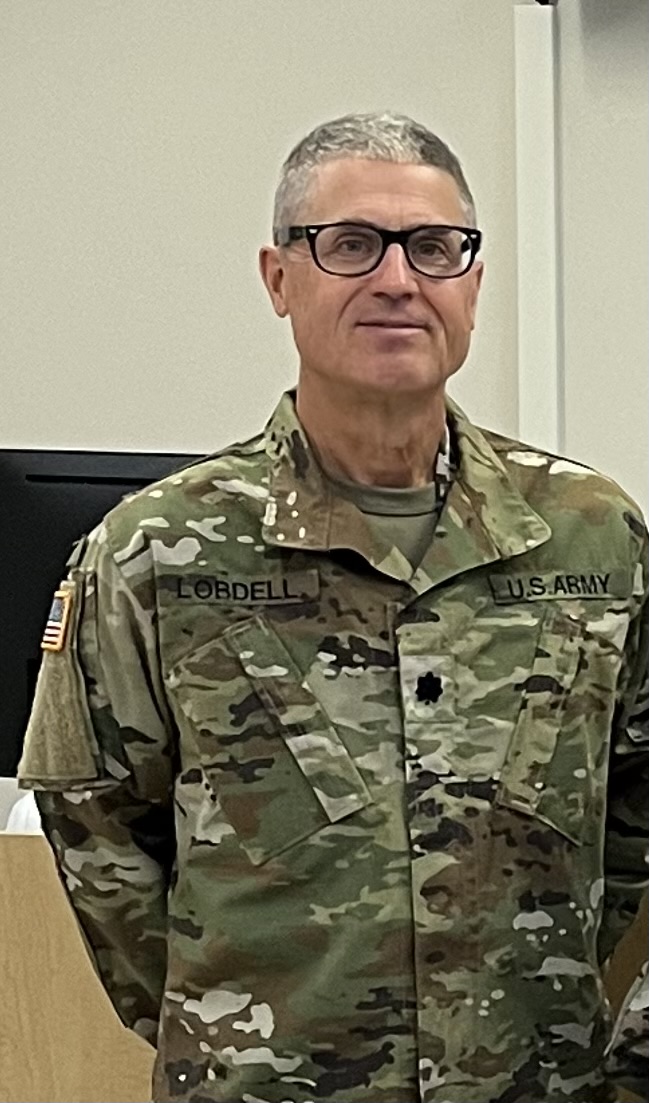
Dr. Kevin W. Lobdell is a cardiothoracic surgeon at Atrium Health Sanger Heart and Vascular Institute and a Lieutenant Colonel in the U.S. Army Reserve who commissioned at sixty years old, more than thirty years into his surgical career. He trained under the men who built cardiac surgery from the ground up, attended the University of Michigan Ross School of business two decades into his practice, and built Perfect Care, a remote monitoring platform that has enrolled more than 3,500 patients at Sanger and cut 30-day readmission rates to less than a third of the national average. He tracks his exercise, HRV, and recovery. He gives people Clayton Christensen’s How Will You Measure Your Life and then lives inside the question. His father survived the Battle of the Bulge. A charcoal drawing of the two of them hangs in his office. He sees it every day.
The Open Chest
The nurse wasn’t joking.
Kevin Lobdell was an intern at the University of Minnesota in 1986 when she told him there was a patient to prepare. He assumed it was hazing, a test of composure dressed up as a task. She came back thirty minutes later with the same level expectation, and the look on her face settled it. There were tubes of blood, a full unit worth for matching and laboratory work. He drew them all, got the patient ready, and followed the case downstairs. He was excited about what would follow.
The room was quiet except for the machine. The heart-lung bypass pump ran its steady mechanical rhythm, doing the work a heart was supposed to do. And where the heart should have been, in the cavity beneath the sternum, there was nothing. Just light. Just space. The absence of the thing that was supposed to be there.
Lobdell stood at the edge of the table. He did not move.
The patient was a retired Navy service member who had flown in from Alaska to reach this operating room, and that distance alone told Lobdell something: this was the edge of what medicine knew how to do. He hadn’t known the hospital performed transplants. He didn’t know yet whether he would be any good at what he was watching. The donor heart arrived. The surgeons began sewing it in. An intern who had arrived that morning with no particular expectation stood at the table and understood, without being able to say it yet, that he was going to spend his life here.
“This is amazing. I need to know more. I want to spend more time with these people in this arena.” Lobdell says.
He was passionate about it. In the calculus he’d spend the next four decades refining, that was enough to move.
The People Who Built It
Cardiac surgery in 1986 was young enough that the men who invented it were still making rounds. C. Walton Lillehei, the surgeon credited with establishing the field at the University of Minnesota, came back late in his career and walked the hallways in a way that made the history feel present rather than archived. Stuart Jameson led the program during Lobdell’s time, and the institutional disposition was unambiguous: this was a place that went first.
Living related lung transplants. Living related liver. Living related pancreas. The schedule held procedures that hadn’t been normalized anywhere else. One day Lobdell put a heart-lung transplant on the OR board and didn’t realize until he was looking at it what he’d written. He asked Jameson about it. Jameson told him they were doing it today. No preamble, no particular preparation. The department didn’t announce the unprecedented. It performed it.
Lobdell went from Minnesota to Yale for cardiothoracic surgery, to Children’s Hospital of Philadelphia for pediatric cardiac surgery, then to Royal Children’s Hospital in Melbourne, Australia. He applied to one college. Found out early he’d be admitted to the medical school he wanted and didn’t open the other letters. When he decided on Yale he wasn’t particularly interested in alternatives. He was working backward from conclusions he’d already made, without knowing yet what making them would cost.
What the Arena Requires
Ask him to describe cardiac surgery, and he doesn’t reach for the obvious language. He reaches for its characteristics. Fast-paced. Time-delimited. High-stakes. Results-oriented with no ambiguity about the result. You either restore function or you don’t, and you know before you leave the room which one happened.
He has come to understand this is not a description of cardiac surgery. It’s a description of him. The same framework is what he uses when he coaches his daughters or works with veterans transitioning out of special operations through the Honor Foundation: what are you genuinely good at, what do you have the energy and passion to sustain over time, and what does the world actually need? Find where those three converge. That’s not a career decision. That’s the whole architecture of a life.
For most of his first twenty years in practice, the OR answered all three questions at once. It would take an automobile accident, a business school, a golf course, and a second phone call from a coach’s wife for him to understand how far outside the operating room his answer actually extended.
What the OR Couldn’t Scale
“Two-thirds of the facts & two-thirds sure I’m right.”
In 2007, Lobdell enrolled at the University of Michigan Ross School of Business, nearly two decades into his surgical career. The question that drove him there wasn’t about surgery. It was about multiplication. He could perform at a high level. He wasn’t certain he could lead at the level where performance gets replicated across other people and other systems. In the language he’d learn at Ross, he was strong in the tactical and operational domains and falling short in the strategic one. He didn’t know that yet. That was the problem.
The framework that shifted his thinking was called competing values. The lesson wasn’t technical. It was relational: instead of asking why the people around him didn’t think the way he did, he started asking who he needed in the room to solve problems no single perspective could reach. That move, from self-referential to systemic, from doing to building, is what Ross gave him that the OR couldn’t.
He says, in his lighter moments, that “I typically had two-thirds of the facts & was two-thirds sure I was right” when he looks back at those early decades. One school application, no backup plans, a relentless forward motion he’d run on before he had the language to explain it. What he calls pragmatism; others might call faith in a direction he hadn’t fully mapped.
What Sanger Said Yes To
The first call was manageable. The second one changed everything.
A former Panthers coach had a cardiac event on a golf course in Charlotte and was brought into Sanger Heart and Vascular Institute. Lobdell oversaw the care. It went well. The coach was discharged four days post-operation. Clean outcome. See you in a couple of weeks.
Except the coach wanted to return to the sideline, and there was a timeline, and Lobdell stayed more involved than he would have with a typical patient. The first weekend at home, the wife called. Her husband was lightheaded. What’s his blood pressure?
She didn’t know. They didn’t have a cuff.
“Smart, sophisticated people with resources, but they don’t even have something that simple.” Lobdell says.
Around the same time, he’d been standing at a different patient’s bedside at Sanger and heard a family member say they hadn’t spoken with a doctor in two days. His daughters were old enough to use smartphones. The gap between what the technology could do and what the care system was actually doing stopped being an observation and became an indictment. He developed a four-quarter plan for the coach’s recovery, walked with him every day for a month, and watched the failures of the existing system appear in real time. Every gap he found became a requirement for what he was already building.
Sanger is an institution built for exactly this kind of problem. Founded in 1956, it operates across more than twenty care centers throughout the Carolinas, holds a Society of Thoracic Surgeons three-star rating placing it in the top ~10% of programs nationally, and has earned the American College of Cardiology’s Platinum Performance Achievement Award eleven consecutive years. It participates in 51 industry-sponsored clinical trials and hosts 66 investigator-led studies and registries. When Lobdell brought the concept of continuous remote cardiac monitoring to the institution, Sanger didn’t need to be convinced that innovation was part of the job.
Perfect Care, funded by the Duke Endowment, has now enrolled more than 3,500 patients within the Sanger system. Roughly 98% are discharged to home, against a national average of ~80%. They stay approximately one day less. They return about 40% less often. The 30-day readmission rate sits near 4.7%, against a national average closer to 15%. A follow-up appointment is a picture. Continuous remote monitoring is a movie. What you catch in a movie is everything the picture missed, and what it misses in cardiac recovery is often what kills.
The Uniform
“If I don’t do this, who does?”
Kevin Lobdell has been giving people Team of Teams for years. The book is Stanley McChrystal’s argument for how organizations built for efficiency collapse under complexity, and how you rebuild them around shared consciousness and distributed decision-making. Lobdell had been living inside that argument long before he had the language for it. When McChrystal eventually put a uniform on him, it was not a coincidence. It was a convergence.
He started the process with Army recruiters in 2018. The country was eighteen years into the Global War on Terror. He’d been thinking about this for longer than he could account for, drawn toward it through history and family and a specific affinity for the veteran patient population he’d treated throughout his career. Veterans were grateful without being transactional. There was a particular esprit de corps in those clinical settings that didn’t exist elsewhere. He’d been thinking about it for years. He hadn’t been moving.
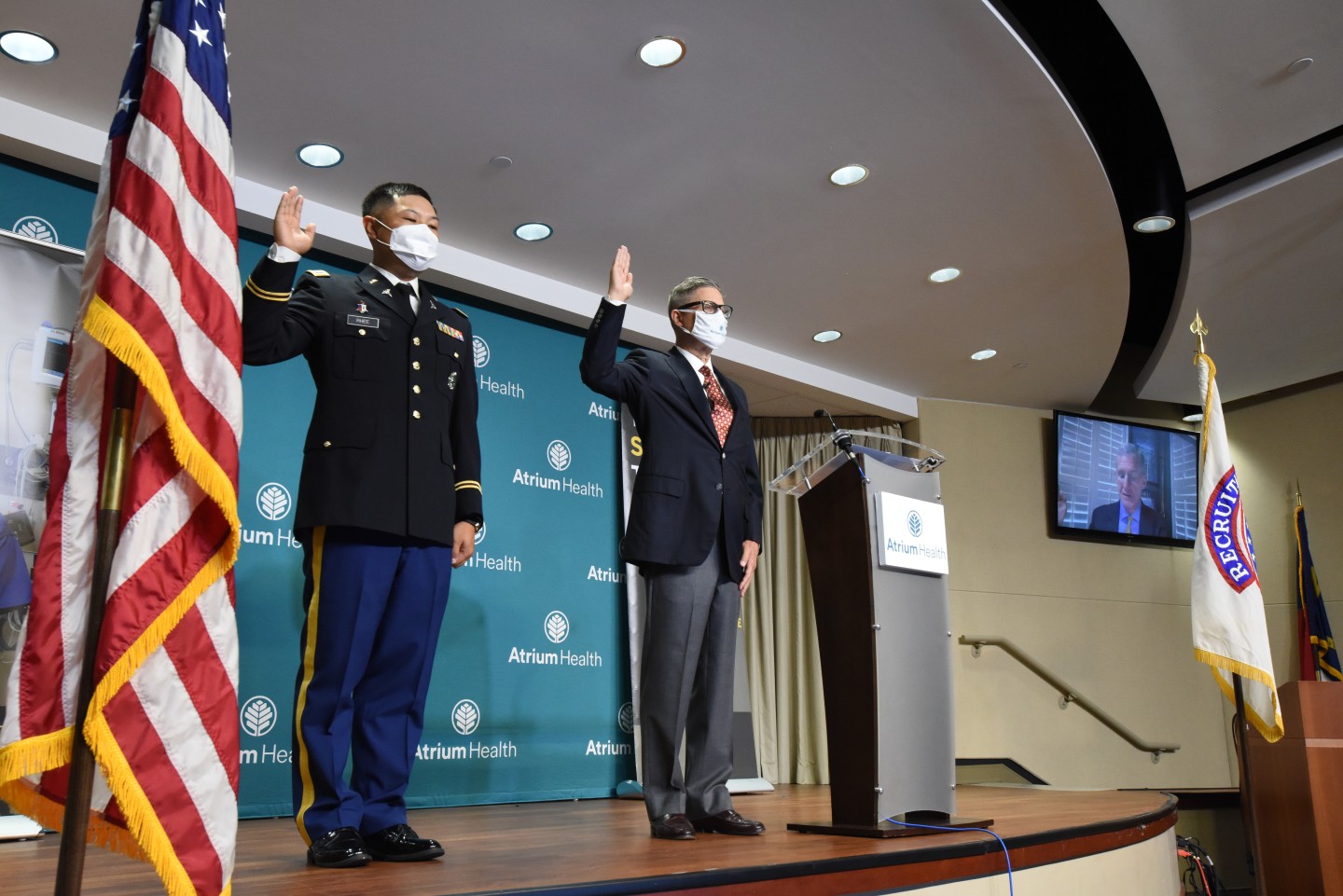
What moved him was a question he couldn’t answer any other way. “If I don’t do this, who does?” On August 13, 2020, at sixty years old, he raised his right hand. When the paperwork arrived after the ceremony, there was a contract he hadn’t fully anticipated, terms he hadn’t known to expect, including the fact that Reserve officers receive pay. He’d said yes before he knew what yes meant. That, he acknowledges, was entirely consistent with his whole life.
The Charcoal Drawing
Gene Woods, CEO of Advocate Health, served as master of ceremonies at the commissioning. Woods leads the third-largest nonprofit health system in the United States, an organization of 69 hospitals, 167,000 employees, and nearly six million patients across six states. He did not have to be there. He chose to be. Afterward, Woods commissioned a charcoal rendering of Lobdell and his father from photographs of that day. It hangs in Lobdell’s office. He sees it every morning.
His father is a World War II veteran who went through the Battle of the Bulge and came home different. When Lobdell was young, his father had night terrors the household didn’t have language for. Today you’d call it post-traumatic stress. For years, the war lived in that house the way it lives in a lot of houses: present, unnamed, carried in the body rather than the conversation. What his father had seen, he had kept. What he had kept, he carried alone.
It wasn’t until Lobdell commissioned that the distance between what had been experienced and what could finally be said began to close. He asked his father once what a day in the life had looked like.
“In one word, it was hell.” his father said.
Then the specifics came. Four months without a shower, from the start of the Bulge to the first time conditions permitted it. A castle in Germany where it finally happened, which his father later saw on the History Channel and called to tell him: that’s the place. Concentration camps, liberated. Things a man doesn’t say to children who aren’t yet prepared to hold them. The things his father had been waiting to say. The things Lobdell had been waiting to be old enough to ask. Two men, a uniform between them now, finally in the same conversation.
The drawing holds both sides of that. The weight of a son who became something his father made possible. The silence between them that was never empty, only waiting.
One Problem, Two Theaters
The biosensor logic that built Perfect Care is the same logic the military has been developing for a different purpose, and Lobdell sits at the intersection. Steps, sleep, heart rate variability: in a cardiac patient recovering at home, those signals indicate whether recovery is on track or about to break. In a deployed soldier, the same signals can support casualty triage, remote monitoring of the injured, and a commander’s real-time picture of troop readiness across an entire theater. Two populations. One problem. One man who has spent decades on both sides of it.
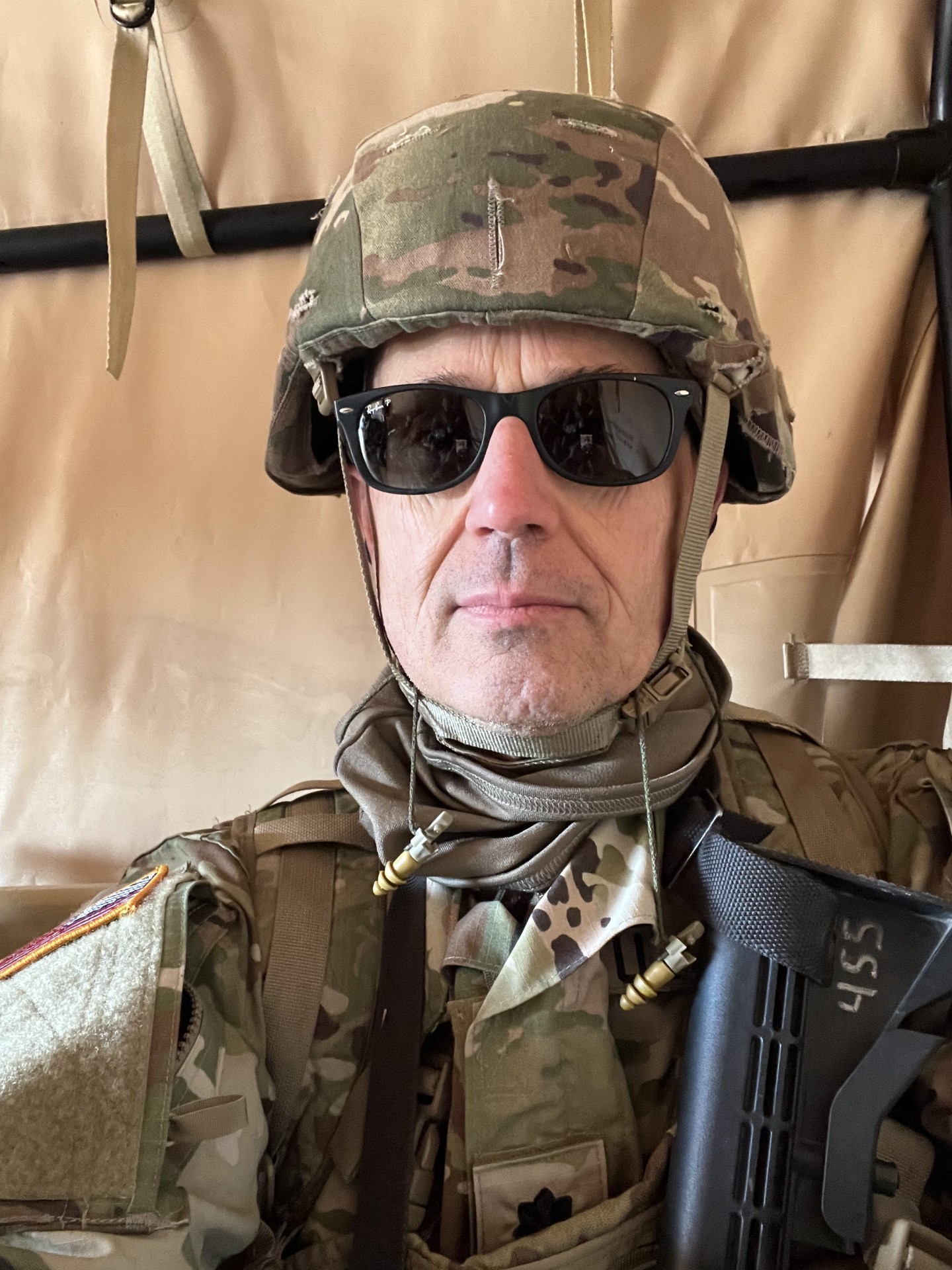
In 2024, Lobdell was selected to augment the Office of the Command Surgeon during a Europe-wide war exercise. The scale was categorically different from anything in civilian medicine. Different NATO countries with different standards for blood procurement and testing. Tens of thousands of simulated casualties to move and treat across a continent without the air superiority that had defined the previous twenty years of conflict. Trains pressed into casualty evacuation. Civilian hospitals and ships used as staging facilities.
What he found was that the planning hadn’t caught up to the problem. When the front line moved, the question of where to reposition the medical support elements came afterward, not before. If you were planning to advance, why hadn’t someone already scouted the territory? The military learns fast. Tools for proactive and predictive planning now exist that didn’t before that exercise. But you cannot address a gap until you surface it. That principle holds equally in a chest cavity and across a continent.
What It Takes
Ask him what the work costs in the places that don’t appear on a curriculum vitae, and he doesn’t reach for a comfortable answer. It’s the social things. Time with his wife of twenty-eight years. Time with his two daughters. The cumulative weight of presence given to rooms that weren’t home. His mother said it to him plainly during his general surgery residency: you spend more time with people you don’t even know than you do with your own family. He has thought about that sentence for decades.
The answer he’s arrived at is that it’s somewhat selfish, and also inextricable from who he is, and also imperfect, and that the family has come to understand both the arrangement and the man inside it. He has more self-awareness about it now than he did at thirty. He says yes to things he’d declined for years. He tries to be somewhere when he’s there.
His daughters are grown. One studied abroad for a semester. One went on spring break with friends and handled the logistics on her own. He says there is nowhere you could have sent him that would have made him smile the way the pictures from those trips did. That’s the arc now. Not the case. Not the data. The pictures.
How He Measures It
“Energy is finite.”
He tracks his own recovery, strain, and heart rate variability the same way he tracks patient outcomes. The logic that applies to a cardiac patient at home applies to the person managing that patient’s care. You cannot give what you haven’t maintained. The data tells you where you are. What you do with it is still a choice.
He coaches veterans transitioning out of special operations through the Honor Foundation. He advises on biosensor applications at the intersection of civilian and military medicine. He operates. He teaches. He adjusts. At some point in all of it, the pattern that emerges is the same: knowing where you are clearly enough to decide, then deciding without waiting for certainty you’ll never have.
For Lobdell, the framework is Clayton Christensen’s question: how will you measure your life? He has been giving that book away for years. He has been living inside the question for longer. Time is the most precious resource, he says, but time is only part of it. “Energy is finite,” he says, and what that means practically is that you cannot spend it everywhere without losing the ability to spend it where it matters. As he has gotten clearer about what he can uniquely offer, he has gotten better at saying no. Not as discipline. As consequence.
“Smile, learn, improve, and keep going.”
He shares this with his daughters. He shared it long before he had a uniform to wear when he said it. The simplicity is not a reduction of his sophistication. It’s an expression of it. The most rigorous thinkers arrive, eventually, at frameworks that survive pressure without breaking down. This one has.
Things come at you every day. You have a binary choice. You can be upset about it or you can smile. If you smile, you’re in the right frame of mind to deal with what’s actually in front of you. It sounds simple because it is. It takes most of a lifetime to actually do it.
“Smile, learn, improve, and keep going,” he says. The cycle doesn’t end. It just keeps going round and round.
In 1986, an intern stood at the edge of a table in Minneapolis and looked at a space where a heart used to be. He didn’t know what the absence was asking of him. He didn’t know it would take forty years, a business school, a platform, a uniform, and a conversation with his father about hell before he’d understand what he had actually walked into that room to find.
Some people walk into a room with nothing in the chest and see a problem to solve. Kevin Lobdell walked in and understood, without knowing he understood it, that he was going to spend his life in rooms like this one. He just needed to know more.
He still does.
Resources
Atrium Health Sanger Heart and Vascular Institute │ atriumhealth.org/heart-care
The region’s most comprehensive cardiovascular institute, with more than fifty years of care, 175 providers, twenty care centers across the Carolinas, and national rankings in all six evaluated heart conditions and procedures. Home of Perfect Care.
Advocate Health │ advocatehealth.org
The third-largest nonprofit integrated health system in the United States, serving nearly six million patients across 69 hospitals in six states, with a mission to redefine care from discovery to everyday moments.
Perfect Care │ Advocate Health │ advocatehealth.com
Remote monitoring and patient engagement platform for cardiac recovery, developed by Dr. Lobdell and funded by the Duke Endowment, with more than 3,500 patients enrolled and readmission rates less than a third of the national average.
The Honor Foundation │ honor.org
Fellowship program supporting special operations veterans in transition through coaching, curriculum, and professional community.
Veterans Crisis Line │ Dial 988, then press 1 │ veteranscrisisline.net
Free, confidential support for veterans and their families, available 24 hours a day, seven days a week.
75th Innovation Command │ U.S. Army Reserve │ usar.army.mil
Army Reserve unit where Dr. Lobdell currently serves, applying data, remote monitoring, and analytics to military medicine at scale.
About Dr. Kevin W. Lobdell
Dr. Kevin W. Lobdell is a cardiothoracic surgeon at Atrium Health Sanger Heart and Vascular Institute, where he has practiced for more than thirty years. He trained under C. Walton Lillehei and Stuart Jameson at the University of Minnesota, completed cardiothoracic surgery training at Yale, pediatric cardiac surgery at Children’s Hospital of Philadelphia, and a fellowship at Royal Children’s Hospital in Melbourne, Australia. He holds a certificate in Health Care Management from the University of Michigan Ross School of Business and is the architect of Perfect Care, a remote monitoring platform funded by the Duke Endowment that has enrolled more than 3,500 patients within the Sanger system. He commissioned as a U.S. Army Reserve officer in 2020 and currently serves as a Lieutenant Colonel with the 75th Innovation Command. He and his wife have been married twenty-eight years. They are based in Charlotte, North Carolina.
Learn More │ veteranexcellence.org
Veteran Excellence amplifies the voices of those who serve, and those who love them.