

Summary
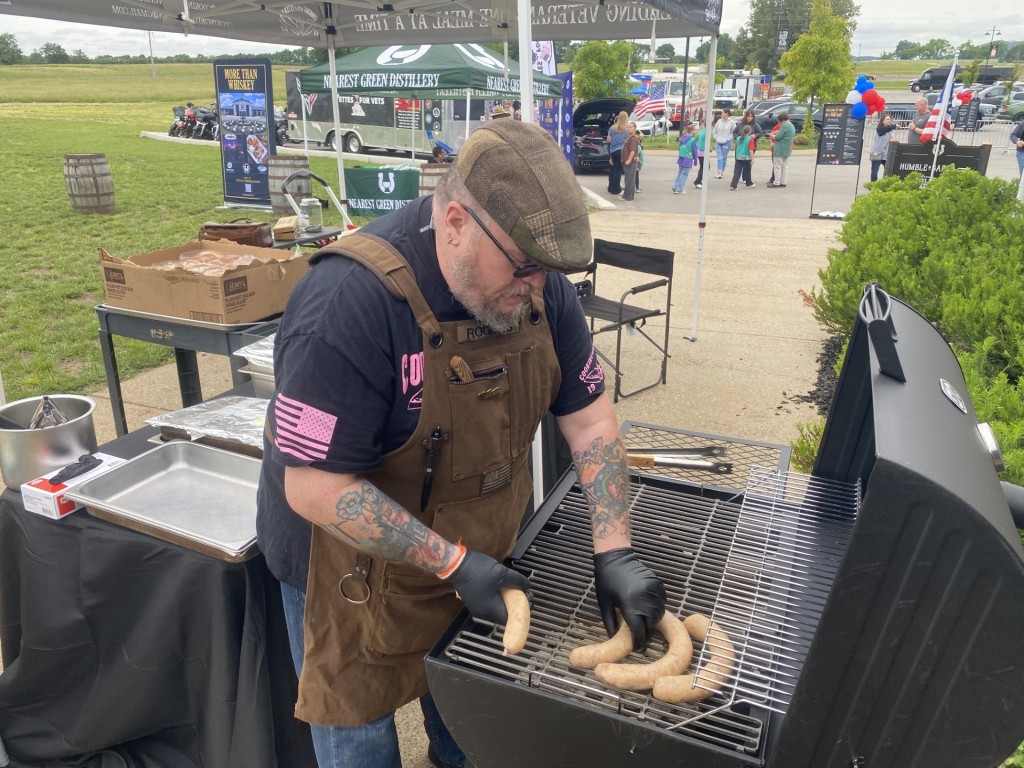
Dave Rogers went from homeless teenager to Army veteran to founder of Cooking with a Veteran Inc., a nonprofit fighting food insecurity for veterans and their families. After serving with the 1-69th Infantry and working as a first responder at the World Trade Center on 9/11, Rogers discovered that feeding veterans wasn’t just about providing meals. It was about restoring dignity. Now based in Tennessee with his service dog Grunt, Rogers uses cooking as a platform to connect veterans, advocate for legislation, and remind warriors across the country that they’re not alone. Through social media cooking shows, cookbooks, and partnerships with the VFW National Home, he’s creating community one meal at a time.
From the Streets to Service
Dave Rogers knows what it’s like to be hungry.
“Being homeless at 15, you know, really throws a wrench in everything. You basically are fending for yourself,” he says. “I was lucky, though. I had people in my life, like my guidance counselor at middle school, that wouldn’t let me quit.”
Rogers joined the Army in 1989 because he wanted to go to college. As a homeless teenager without an address or guardianship, he couldn’t get student loans. Back in the mid-80s, even wards of the state were still classified under their parents’ income for financial aid purposes.
“I knew the only way I was gonna get out of the situation after I graduated high school was if I joined the army.”
Once in, Rogers took full advantage of everything. “I did not waste any opportunity at all. I went to school as much as I could. I traveled as much as I could. I did all the things I wanted to do in life.”
Stationed in Germany, he traveled all over Europe. Stationed in Korea, he explored Asia. When deployment opportunities came up, he volunteered. He put himself on a Pentagon volunteer list that would call him with opportunities.
“I’ve been living here in Tennessee, where I live now, four years. That’s a long time for me,” he laughs. “I never really felt the sense of I have to be in one place forever. I wanted to do all this stuff. I look at my father. He’s never been outside of the United States. He doesn’t have a passport. I was like, I want to see the world. I want to go to college. I wanna do all this crazy stuff. So I did.”
9/11: No Escape from Home
In September 2001, Rogers had just returned to New York a month earlier. He was on vacation, waiting to connect with his unit, when the World Trade Center was attacked.
“It was weird because I’ve been overseas. I’ve seen things overseas. This was different because this was where I grew up. I grew up in New York. The World Trade Center opened in 1973, and I was born in 1969. I grew up at the time of the World Trade Center. And there I was, back in New York. And all of a sudden, I’m thrown into everything.”
Visually, it might have compared to what he saw in Bosnia. But because it was at home, there was no comparison.
“You deal with trauma when you go to Bosnia or Iraq. But then you go home. You come away from it. Here I am in New York, and it’s on the news every day, and we’re hearing about it every day. And then there’s ceremonies about it every year. I’m not there anymore doing rescue anymore, because they’ve gotten past a certain point. But now I’m doing Homeland Security in New York, and I’m still in New York. Even after I got out, I was still living in New York. There’s no escape. There’s no disconnection.”
When you go overseas to conflict, you don’t think about what happens to the people who are left behind, the people who live there and have to live through that.
“We had to live through that. And then it became every year there was a memorial service. It was like a never ending. I struggled to live with that.”
When Food Becomes Medicine
After leaving the military, Rogers found himself without benefits and couch surfing. He broke his neck. He was at the VA three or four days a week for physical therapy, occupational therapy, PTSD treatment, dealing with traumatic brain injury and vertigo. No one was hiring him.
“No one’s saying, Let’s give you a job, and we understand that you can’t be here every day.”
That’s when something clicked for him.
“I could be at the VA all the time. I could be doing therapy all the time. I could be taking medication all the time. But if I go home, and I can’t put food on my table, and I can’t pay my rent, and I can’t put gas in my car, and I don’t have a job, it’s hard to get better. Stress on top of stress doesn’t work.”
During the pandemic, Rogers was living in New York, serving as commander of the Suffolk County VFW. He started getting phone calls from older veterans. Korean War veterans. A couple of World War II veterans. Older Vietnam veterans.
“They were like, Listen, we’re not getting hot meals. Island Harvest closed their kitchen. They’re just dropping boxes of food. I’m 90 something years old. I’m not standing in front of my stove trying to cook. I could barely stand up. What am I supposed to do?”
Rogers and a couple of VFW members started driving around, picking up those boxes, cooking the food, and bringing hot meals back to the veterans.
That’s when they realized it was a much bigger problem than they’d thought.
“The VA says one in five veterans struggle to put food on their table. I think the number’s higher, because you gotta understand that only 46% of veterans actually use the VA.”
When Rogers wasn’t getting his benefits, the VA in New York had a program where veterans under 70% disability could get a grocery shopping card to help put food on the table. That program is gone now.
“Many places where I live in Tennessee, a lot of the food banks don’t have fresh produce. They don’t provide meat. You can’t get dairy products. They basically just have canned goods and boxed goods, which is not healthy for you. But there’s also this stigma. You served your country, and you’re struggling, and you’re standing in a food line. There’s a dignity thing there.”
Cooking with a Veteran wanted to provide grocery shopping cards because nobody knows. “You’re not standing in a food line. You go to your social worker at the VA. They give you a grocery shopping card, you don’t feel embarrassed, but also you’re able to buy stuff that’s more healthy. You’re able to buy meat, you’re able to buy milk, you’re able to get bread and cheese, produce. All these things that a lot of food pantries don’t carry.”
People think that just because you get your benefits, you should be good to go.
“100% right now is $3,900 a month. Sounds like a lot, but you gotta take into account that average rent is $2,200 a month. By the time you pay your rent, your car payment, your phone, put gas in your car, there’s not a lot of money left over at the end of the day. And it hasn’t gone up much. When I first got out, 100% was $3,000. It’s only gone up $900 in 22 years. Back then, rent would probably be maybe 900 to 1,000. Rent’s now 2,200. So that’s half of my take home just in rent. By the time you get done, you’re lucky if you have four or $500 left over to buy food for the month.”
This is what people don’t understand. They think if you’re a veteran, you’re just rolling in the dough.
“You’re not. And that’s why we want to help veterans, because we know that food insecurity is huge amongst veterans. We know that if we can help them put food on their table, that’s one less worry they have. They can say, Okay, I can put grocery on my table. I’m okay. I’m not perfect, but I’m okay.”
Grunt: The Partner Who Saved Him
Before Rogers got Grunt, his service dog, he sometimes wouldn’t leave his apartment for weeks on end.
“I was just fine just sitting at home by myself for weeks on end. I wasn’t talking to anybody.”
His doctor suggested a service dog. Grunt came from an organization called Paws of War in New York. Grunt was trained for Rogers’ anxiety, his diabetes, his nightmares, and his vertigo.
“He knows when I’m having anxiety. He knows when I get vertigo. He knows when my blood sugar’s going low. He signals me what to do.”
They’ve been together eight and a half years now. Grunt is 11.
“We go everywhere together. Grunt is always by my side. He makes it possible for me to get out and do things, and talk with people.”
Rogers tells a joke that when you get a service dog, you become irrelevant.
“People see Grunt, and they’re like, Look, there’s Grunt. And that guy with Grunt. You become secondary.”
But it’s not always easy. People have thrown food at Grunt, kicked him, stepped on him. Just the other day, a guy wanted to play with him.
“I was like, Sorry, he’s working. The guy’s like, You’re a selfish asshole. You’re so selfish. I’m like, it’s my service dog. It’s not a pet.”
Part of the problem is all the fake service dogs out there. “It makes it harder for people like me who have a real service dog.”
People ask why he doesn’t just let Grunt be a regular dog.
“You gotta understand. If something happens to Grunt, I can’t just call the agency tomorrow and say, Hey, you got dogs sitting around. They have to train the dog for you, for your need. It takes a year and a half to train a service dog. That’s why I’m protective of him. If he couldn’t do his job anymore, they don’t just have another service dog sitting in the office waiting for me.”
Grunt is trained to recognize when Rogers is having anxiety. “If I’m having anxiety and Grunt’s playing with someone, he’s not going to see the anxiety in me. And that’s why I don’t allow him to play in public, because sometimes I do get anxiety, even still, even now, 20 something years later.”
The Kitchen as a Platform
Cooking with a Veteran started in March 2020 on Long Island, feeding 20 veterans three times a week. Veterans who enjoyed the meals asked if Rogers could share what he was doing. So Cooking with a Veteran went live on social media with weekly videos sharing recipes, tips and tricks, and ideas for stretching the dollar.
“We were doing a daily Zoom every day during the pandemic. Sometimes we were cooking, sometimes we were just talking, sometimes we were doing art classes. We had a couple of art professors teach. We were doing karaoke, we were playing board games. We were doing all sorts of stuff. We had people calling in from 12 different states.”
They even did virtual veteran-in-the-classroom sessions with high schools in Queens.
“That’s when I realized we can reach so many people this way. And it’s not just about saying, Oh, look at me. It’s about saying, You’re not alone. We’re here. There’s always somebody here.”
Rogers travels now, and people recognize him.
“I go up to Michigan sometimes, people will come up to me and say, Hey, I watch your show. I love your show. I love what you do. And that feels great. You’re like, I’m touching people.”
His online cooking program has allowed him to connect with more people and see the different needs of veterans. “It allows me to learn about the resources that are out there, because that’s the other biggest thing. A lot of veterans don’t know what’s available to them.”
Rogers has put together a veteran resource guide for Tennessee that’s free on his website. It lists blacksmithing PTSD healing programs, barbecue programs, motorcycle programs.
“Being out there cooking, I listen to what veterans say, and then we take that, and we push for legislation.”
He’s advocating for collapsible crates at VA facilities for service dogs, expanded property tax credits for veterans, a 4.3% interest rate cap for 100% disabled veterans to give them buying power, and the Grunt Service Dog Bill.
“I live alone. I asked the VA, What happens if I’m at the VA one day and I have a heart attack? And all of a sudden, you gotta rush me into the operating room. What happens to Grunt? Nobody had an answer for that.”
Breaking the Myth
The biggest myth Rogers wants people to let go of? That veterans who seem unapproachable or unfriendly are angry people.
“It’s not that they’re not friendly. It’s not that they’re angry people. They’re just dealing with their own little war inside their head. Sometimes I just want to go and grab a gallon of milk. I got Grunt with me, and I walk to the supermarket. And from the time I hit the door, people are coming up. I’m like, I just want to buy a gallon of milk. I just want to be in my head today. It’s not that we don’t want to be more sociable. Sometimes you’re just not feeling it. Sometimes you just want to go about your day and do your thing.”
When he first got out, Rogers hated when people said, “Thank you for your service.”
“It’s hard to admit that you’re no longer in, but also it’s like, but I’m still out here doing stuff. I would tell people, if you see a veteran, instead of saying thank you for your service, say, Welcome Home. How can I help? What do you need? Because that opens up a conversation.”
Food Tells the Story
Rogers has learned dishes from around the world during his service. In Germany, he learned to make duck with a blueberry reduction. In Spain, he learned to make a bell pepper jam that’s really sweet, good on toast. In Japan, he learned to make a popular rice taco bowl.
“That’s what cooking is about. Cooking is about bringing your family together, bringing your friends together. And sharing.”
He’s hoping to expand his program with more veterans coming on the show to talk about their experience while they’re cooking. Maybe a cook-along on Zoom where people make meals together and share stories.
“As a kid, that’s what I remember. I remember on Sunday, the whole family would come together, and we would sit and talk about whatever. That’s what I like to see this program become. A way to share. Not just recipes, but share your story and why this dish is important to you.”
Looking Ahead
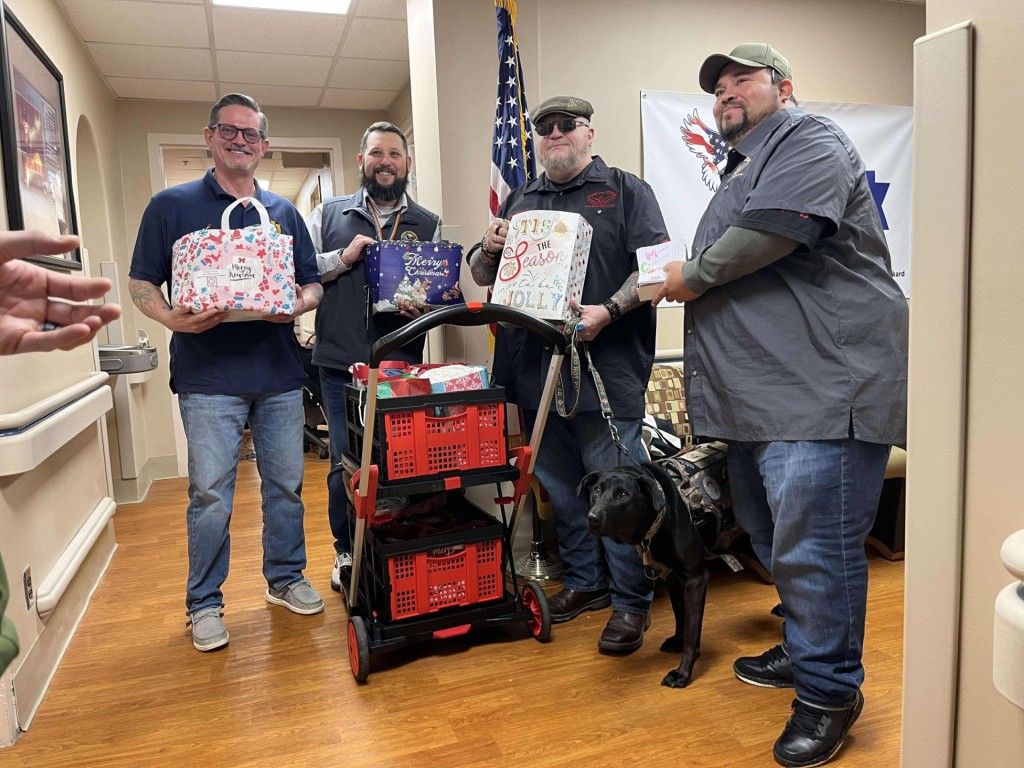
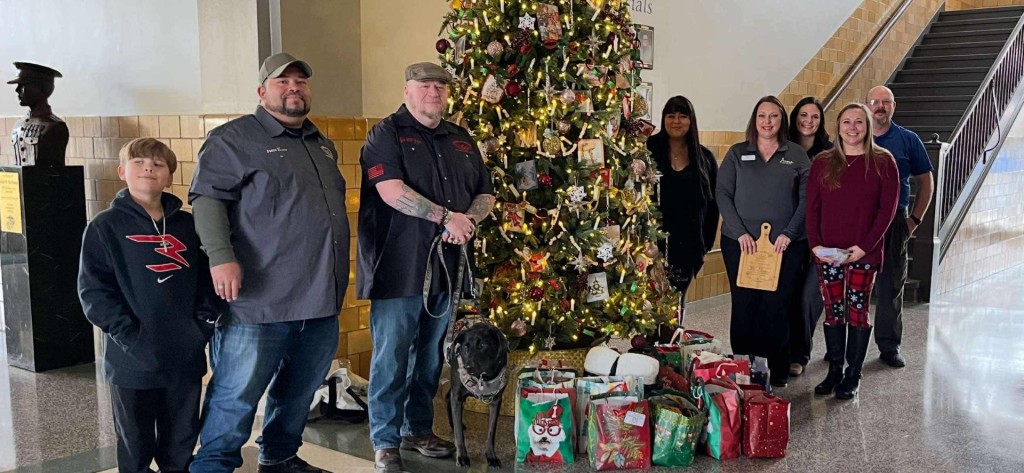
Cooking with a Veteran Inc. incorporated as a 501(c)(3) nonprofit in May 2024. Rogers continues working with the VFW National Home, conducting weekly video classes on social media, and providing cooking classes throughout the community. He’s published a series of cookbooks called “From Bland to BAM” to help people cook good meals on a budget while raising money for the programs.
“We’re looking to do more remote cooking programs and classes, helping to feed veterans, raise money for fighting food insecurities, and support the VFW National Home.”
At 56, with a broken neck, degenerative disc disorder, and the wear of decades of service, Rogers isn’t slowing down. He’s just getting started.
“My service isn’t over. This is what I’m doing for the rest of my life. We’re all working together. Because at one time, we all have gone through something where we understand that we need each other.”
Resources for Veterans
Food Security and Support
Cooking with a Veteran Inc.: cookingwithaveteran.org
Veterans Crisis Line: Dial 988, then press 1 | Text 838255 | Veterans Crisis Line
VA Food and Nutrition Services: VA.gov
Tennessee Resources
VA Tennessee Valley Healthcare System: VA Tennessee Valley Health Care
Cooking with a Veteran Tennessee Resource Guide: Available at cookingwithaveteran.org
Service Dog Resources
Paws of War: Service dog organization
VA Service Dog Benefits: VA.gov Service Dogs
About Dave Rogers
Dave Rogers is an Army veteran who served with the 1-69th Infantry and was a first responder at the World Trade Center on 9/11. After experiencing homelessness as a teenager and again during his transition out of the military, Rogers founded Cooking with a Veteran Inc. in March 2020 to fight food insecurity for veterans and their families. Based in Tennessee with his service dog Grunt, Rogers conducts weekly cooking shows on social media, advocates for veteran legislation, and partners with the VFW National Home. He is the author of the “From Bland to BAM” cookbook series.
Veteran Excellence Magazine celebrates outstanding leadership in veteran healthcare and services.