

Summary
Bryan Watson joined the U.S. Army Reserve while finishing his business degree at Penn State, balancing a civilian career in banking with the unpredictable demands of reserve service. His second activation sent him to Iraq with a unit he had never trained with, to a war that had no defined front line. On April 9, 2004, his convoy was hit in one of the largest ambushes of the entire Iraq conflict. Nine people died. Watson was shot twice and went back. In 2009 he joined First National Bank, the largest subsidiary of F.N.B. Corporation, where he and 8 others helped build the private banking group from scratch and rose to Managing Director. He also leads the Pittsburgh chapter of Defenders of Freedom, a nonprofit providing emergency financial assistance and traumatic brain injury treatment to post-9/11 veterans.
A Foot in Both Worlds
The market was empty. That was the first sign. Watson was standing in the turret of a five-ton cargo truck, the Mark 19 grenade launcher mounted in front of him, when he saw it. The market should have been buzzing. Instead, cars were driving away from them at high speed. Then they came over the overpass. “I see an Abrams tank firing on a village and a soldier waving at us,” he said. “It’s too late. We’re about to get hit.”
That was April 9, 2004. Watson was 26 years old, a banker from Pittsburgh who had been in-country for a few months, providing security for fuel convoys through the Sunni Triangle. He had not grown up planning to be there. He had grown up inside a military family. His grandfather, who was very impactful in his life, fought in World War II with the Marines in Guam. His uncle was an Army Ranger. His stepfather served in the Army. But Watson wanted college. Something in business. He enrolled at Penn State University and made a plan that did not include a uniform.
That plan lasted until his sophomore year, when an Army recruiter showed up on campus. “He had some interesting banners and obviously it was in what he had to offer,” Watson recalled. “Student debt repayment, GI Bill. He said all the right things and basically gave me a path to be able to come out of college with minimal to no debt, plus be able to serve my country. And those things align for my personal beliefs.”
The recruiter squeezed both basic and advanced training into the summer between Watson’s sophomore and junior years without delaying his college timeline. He did not want to slow down. Watson became an 88 Mike, qualified to drive a variety of wheeled vehicles in the military, graduated Penn State on schedule, entered the private sector, and settled into the rhythm of reserve service: one weekend a month and two weeks in the summer.
“It’s hard to truly prepare as a part time soldier,” he said, “because you’re trying to do a lot of training and preparation in a very, very limited amount of time. But you have to be focused. You have to take every minute and second you have at your reserve unit to learn and grow as a cohesive unit and be prepared.”
“The preparation it gave me and the mindset, to be able to handle that down the road, was priceless.”
The first activation came before he was ready for it to matter. His unit, the 298th Transportation Company out of Franklin, Pennsylvania, mobilized to Fort Lee, Virginia and prepared to deploy. Then the mission was canceled. They went home. He had missed the birth of his first son while he was at Fort Lee. “But in hindsight,” he said, “the preparation it gave me and the mindset, to be able to handle that down the road, was priceless.” The second activation would not be canceled.
Cross-Leveled
When Watson was called up the second time, the regional bank where he worked had supported his service in the reserves and understood he could be gone for 12-15 months. What he did not expect was that he would not be deploying with his own unit.
When a reserve unit gets activated, not everyone can go. Health conditions, personal situations, eligibility questions. There is always a percentage that falls off, and when a gap opens, the Army fills it from other units. Watson was an E5 sergeant with the right training. He got the call. He had 72 hours to report to a transportation unit out of Bartonville, Illinois, called the 724th. A unit he had never trained with. He knew almost no one in it.
“The outsiders coming into that unit actually made up the majority,” he said. “So it quickly forced us to get to know each other really fast. We all had our training that was identical, and we all knew what the mission was. But the reality was we had to trust a bunch of people we had no knowledge or background with, other than: you’re a soldier.”

Photo courtesy of Bryan Watson
“Until bullets fly, it hasn’t really clicked that you’re in a combat zone.”
They trained at Fort McCoy, Wisconsin in negative-ten-degree temperatures, preparing to fight in a desert climate because the warmer mobilization sites were full. Then they deployed to Kuwait, received their equipment, test-fired their weapons, and convoyed north into Iraq to Balad Air Base, known at the time as Anaconda, north of Baghdad. Their mission was to haul fuel throughout the Sunni Triangle and to forward operating bases beyond. Watson’s role was security. As an NCO with cross-training on crew-served weapons, he was assigned as a gunner.
The unit they were replacing had seen almost no action. The first few weeks were quiet enough that Watson had time to adjust to the reality of being a banker from Pittsburgh living inside a combat zone. “I was just a banker a couple months ago,” he said. “Now I’m in a combat zone.” That adjustment ended April 6th, when insurgents attacked his convoy. Nobody on his side was hurt. A couple of bullet holes in vehicles. But something had shifted.
“Until bullets fly, it hasn’t really clicked that you’re in a combat zone,” he said. “And then April 6th, that was the first time we saw combat. The first time we saw threat of life to our group. We knew it was out there. We heard stories, but that was the first time it affected us.”
April 9, 2004
The mission on April 9th belonged to Second Platoon. Watson was in First Platoon and had a down day. But word came down that leadership wanted additional gun trucks on the convoy. The insurgency was building. There had been unrest around Abu Ghraib prison outside of Baghdad Airport. The chance of attack on the roads was heightened. Watson and his driver along with other gun truck crews volunteered to go.
The convoy was 23 military personnel providing security, plus civilian truck drivers contracted through Halliburton’s KBR subsidiary, operating military tanker trucks with a soldier riding as security in most cabs. Watson was a gunner, standing in the turret of a five-ton cargo truck, mounted behind a Mark 19 grenade launcher. The average load was 32 to 48 grenades, and it could fire them fast. Their protection was makeshift. The up-armor kits had not yet arrived in country. Welders in the motor pool and skunk werks had fabricated quarter-inch steel plates around the doors and the turret. It was what they had.
The mission changed a couple of times before they left the gate. The final destination was Baghdad Airport, an emergency fuel request. On a normal day, that run took 45 minutes. They never got there. The ambush opened with small arms fire, then RPGs, then mortars and IEDs. Tanker trucks ahead of Watson’s vehicle caught fire. Heavy smoke. The village market had been empty. The cars had been driving away. The signs were there and then they were past them.
Watson engaged muzzle flashes coming from buildings on the left side of the road, working the Mark 19 until he burned through his grenades, then dropped into the cab to grab another can. That is when his driver told him he had been shot. “Hey, you okay? You okay? Yeah. Keep going.” Watson wrapped his own arm where he had taken a round and went back up into the turret. The bullet had felt like a bee sting. Adrenaline does that. While trying to load another can of grenades a second round hit him in the neck. He stayed up and started to fire his M16. “It was just a graze wound. It wasn’t anything that stopped me from continuing to fight.”
The convoy’s standing order in a kill zone is simple: if your vehicle can move, you move. Watson’s truck was still moving. He kept going. When they finally cleared the smoke, he looked ahead. “Don’t quote me, I’ll get you the exact lineup of the vehicles, but I think we’re about the 15th vehicle back out of 26,” he said. “And there were no vehicles left in front of us at that point.” Nine people did not survive the ambush, three military and six civilians with one civilian still unaccounted for today. Two hostages were taken in the chaos, one civilian later escaped, and one soldier, unfortunately, was killed.
“Yes, sir. But if I would have moved the other way, he would have missed me.”
Watson and his driver were evacuated by Black Hawk to the Green Zone. Watson was treated in a hallway. The medical facility was overwhelmed with casualties. A doctor looked at his wounds and told him he had a small arms gunshot wound in his arm and had shrapnel in his neck. Watson told the doctor to look again. “I literally had a perfect hole on one side of my collar, and another hole on the other side of my collar. My body armor, same thing. And I said, sir, I don’t know what’s back there, but this is a bullet.” The doctor told him he was one of the luckiest people he had ever met. Move one way, paralyzed. Move the other, dead. Watson looked at him. “Yes, sir,” he said, “but if I would have moved the other way, he would have missed me.”
His driver was in surgery. A bullet had fragmented passing through his shoulder, and the bleeding was internal. Watson waited. The injuries were serious. They told him his driver might not make it. He did pull through. Then Watson flew to Landstuhl, Germany, and eventually to Walter Reed. He went home for 45 days. Then he went back.
Why He Went Back
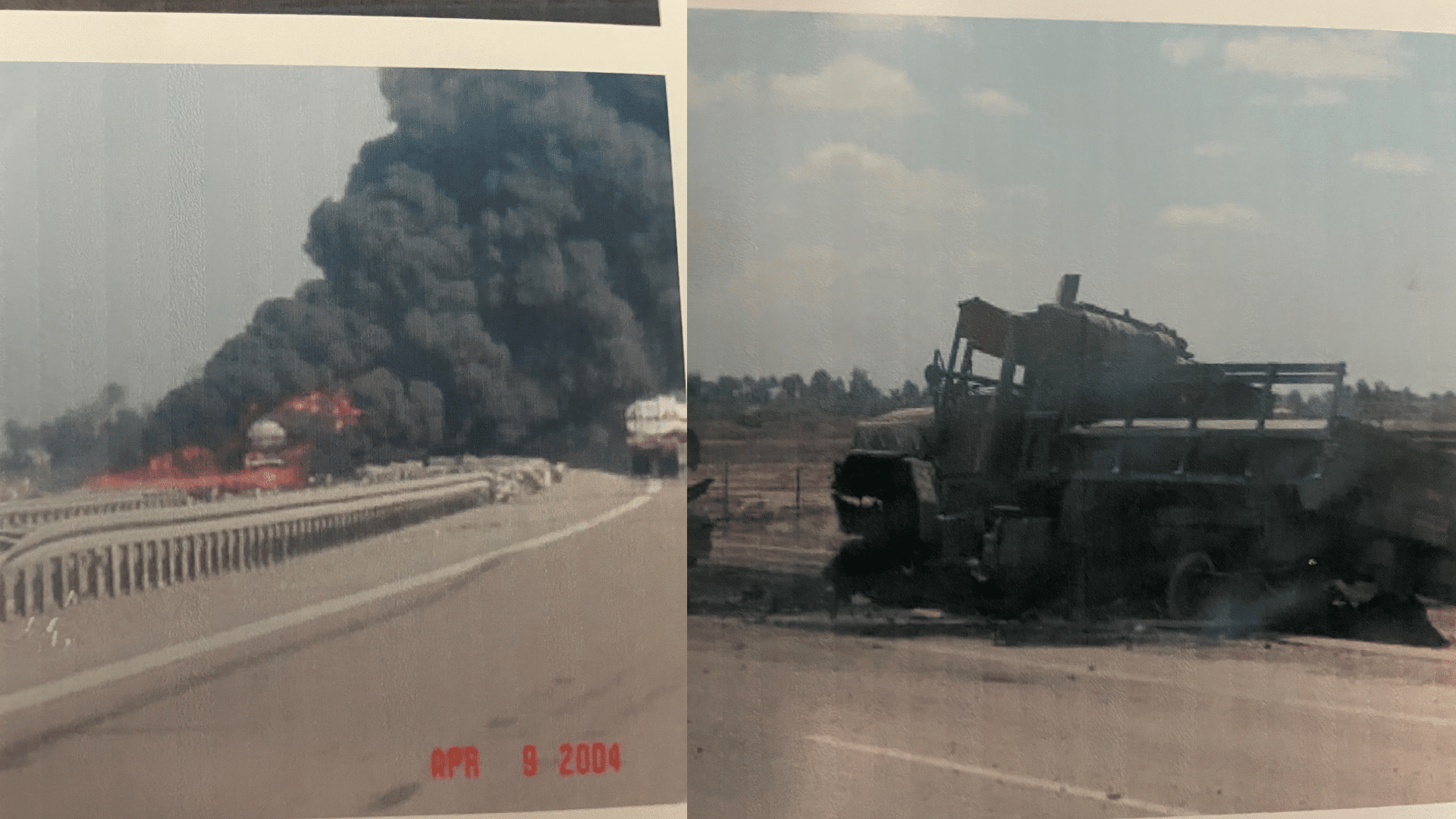
Photos courtesy of Bryan Watson.
“I personally couldn’t live with myself if I stayed home. I would never be able to live with myself.”
Watson does not describe going back as heroic. He describes it as the only thing he could live with. “I personally couldn’t live with myself if I stayed home, which I potentially could have,” he said. “I was capable. Mentally I was fine. My injuries were healing. It was early in our tour. To sit at home, or sit at my job as a banker, and know that my soldiers, my friends, were still over there every day, going through that. And not knowing what happened to Matt and Thomas. I would never be able to live with myself.”
He came home for those 45 days to a support system he credits with saving him. But the preparation for that kind of support had begun long before April 9th.
During the first activation, the one that was ultimately canceled, Watson had done something most people his age never have to do. He updated his will. He confirmed his life insurance beneficiary. He sat with the full weight of what it would mean not to come home.
His girlfriend at the time would be alone with their son, born in March 2003, still barely a year old. The image of a stranger’s voice breaking through the silence of the night to deliver the worst news was something he could not accept. “Getting a call in the middle of the night from a stranger informing her that I was killed wasn’t fair,” he said.
He thought long and hard about who in his life could carry that call without breaking under it. There was only one answer. He listed his mother first. She was the rock of the family and a career nurse, a woman trained to stay steady when everything around her was falling apart. “Her ability to work in stressful situations with a calmness gave me comfort that she would be able to handle that call and build a support system around my family if something truly happened to me,” he said.
That call did come. But the news she received was not the one he had prepared her for. Watson had survived. His mother’s voice was the first one his family heard, and that had been exactly the point.
His former employer had printed and framed a Purple Heart certificate and hung it in the branch office while he was gone, to remind everyone who walked through the door that one of their own was not on vacation.
When he came home for good, he told his story wherever people asked. Churches. Young kids. Friends over beers. He was clear-eyed about why the news covered what it covered. Bad news sell. But he felt the coverage was not the whole picture. “There were so many good things that we did when we were in Iraq,” he said. “You drive down a dirt road and you see kids and families running out of their house barefoot just to say thank you. You’re giving them the candy out of your MRE to these little kids. You tried to give them things that you could.” Those moments did not cancel out April 9th. They existed alongside it.
“I’ve seen every scope inside of people transitioning back home,” Watson said. “I’m one of the fortunate ones that was able to do it. And I think, I don’t even think. I know it was because of the support system I had.”
Building Private Banking at FNB

Photo courtesy of Bryan Watson
“Everybody in life needs a bank. You can’t hide from it.”
Watson came home, finished his tour, and went back to the question he had set aside: what came next? Banking had always made sense to him in a way that was hard to explain to people who had not worked in it. “Everybody in life needs a bank,” he said. “You can’t hide from it. Whether it’s depositing your paycheck or Social Security benefits, financing your first car or home, helping fund your children’s education, or planning for retirement — it touches every stage of a person’s life.”
That scope was the point. “A bank has such an immediate impact on somebody’s life from start to finish,” he said. “Being able to help people, advise them on their life events, build a longstanding relationship — that provides fulfillment. Versus just selling a product and moving on.”
In 2009 Watson joined First National Bank, the largest subsidiary of F.N.B. Corporation, at the moment the institution was building out its private banking group as a formal line of business. He was not walking into an established department. “I joined FNB when we started private banking as a line of business, back in 2009, which was a highly attractive opportunity,” he said. “My roles evolved from a private banker, to a regional manager, to ultimately a couple of years ago being able to take on the position as Managing Director. My blood, sweat, tears are in this line of business and I’m extremely proud of what we’ve built.” Most people who hear that from a banker assume he is talking about revenue. Watson is talking about something else entirely.
“FNB’s culture closely mirrors my military experience,” he said, “grounded in strong camaraderie, teamwork across units, and a clear, mission-driven focus.”
He has spent enough time in both worlds to know how rare that is. Most institutions talk about culture. Few of them build one you can actually feel when you walk in. “Just as in the military, colleagues support one another, collaborate toward shared objectives, and remain aligned around serving a greater purpose.” At FNB, he said, that purpose is simple: help the client succeed. After everything he has seen, simple is not nothing. Simple is the whole point. “This shared sense of mission makes FNB a uniquely rewarding organization to be part of, and one I am proud to serve.”
FNB is one of the 50 largest bank holding companies in the United States, with a footprint across seven states and Washington, D.C. He runs his team the way he ran a convoy. You plan. You execute. You learn from what went wrong. “I will never ask somebody to do something that I’m not prepared to do,” he said. “When I was a branch manager, I knew how to do everything in that branch operationally. Same as in the military. I’m asking people to put their lives on the line. We might not all come back, but we’re going to have each other’s back. And at the end of the day, we’re going to train, we’re going to prepare, and if we fail, we’re going to come back, we’re going to learn from it, and we’re ultimately going to execute better next time.” Complacency, he says, is the one thing that ends careers the same way it ends missions. “The day that you get complacent is the day you get passed over, whether it’s a promotion, whether it’s you miss an opportunity to win a sale.” The skills that you learn in the military translate extremely well into the private sector, when you have the right skills, training and preparation you can become an elite soldier or an elite banker.
“Anytime I’m having a bad day, I look at that tree. And it reminds me I’m really not having a bad day.”
His clients do not always know his history. He does not lead with it. But when someone is in a panic about a market swing or a deal falling apart, they are sitting across from a man who wrapped his own arm in a burning kill zone and kept firing.
There is a small object that has sat on his desk since he came home from Iraq. A woman from the Philippines was working on the base, cleaning showers and bathrooms, making arts and crafts in her downtime. She took a piece of copper wire, coiled it around a piece of wood, and shaped it by hand into a tiny bonsai tree. Watson brought it home in his ruck. It has been on his desk everywhere he has worked since. People walk into his office and stop. Sometimes they just stand there. He has had colleagues appear in his doorway without a word, and when he asks what is going on, the answer is the same: I needed to look at the tree today. “Anytime I’m having a bad day, I look at that tree,” he said. “Reminds me I’m really not having a bad day.” He paused. “What we think is a stressful day, a bad day, is nothing compared to what the men and women are experiencing overseas every single day.”
Defenders of Freedom: The Work That Cannot Wait
About a decade ago, Watson joined the board of the Pittsburgh chapter of Defenders of Freedom, a 501(c)(3) non-profit. It launched October 1, 2014. He has led it as president since 2017. The chapter provides emergency financial assistance to post 9/11 veterans in the gap between military service and civilian stability. Rent. Utilities. Minor car repairs are typical assistance provided to keep these veterans and their families in their home and safe.
“Somebody had a greater mission for me in life. So my job in life now is to take and maximize every day, every second I’m here.”
“I’ve been given a second chance,” Watson said. “Why I wasn’t one of those people that didn’t make it out that day, somebody had a greater mission for me in life. So my job in life now is to take and maximize every day, every second I’m here. With my family, with my friends, with my colleagues at work, my clients, paying it forward to the veteran community.”
The suicide rate among veterans is personal to him, not a statistic. Some of the men he served with have taken their own lives. He holds that alongside the nine from April 9th. When a veteran facing eviction or unemployment has somewhere to turn, he believes it changes what comes next.
In recent years the work expanded to include traumatic brain injury treatment. TBI has become one of the defining wounds of post-9/11 service. Blast exposure from IEDs, the same weapon insurgents used to target supply convoys like Watson’s, can cause neurological damage that does not show on a standard scan and does not respond to standard treatment. Defenders of Freedom now offers a two-week intensive program through functional neurology, combining neurological therapies and metabolic wellness for veterans who have not found relief through conventional channels. Watson was in vehicles that absorbed blasts. He has also sat across from veterans who could not explain what was happening to them, whose families had stopped recognizing them. The program grew because veterans kept showing up with injuries no one had named yet.
Twenty Years of Distance
Two from that convoy were taken captive. Thomas Hamill, a civilian contractor, escaped after 24 days in captivity, prying open a door and running toward a passing U.S. convoy when he heard it on the road. Staff Sgt. Matt Maupin was not as fortunate. His remains were not recovered until 2008. Watson carries that too. “The soldiers and civilians on that convoy that day all displayed heroic fortitude, being greatly outnumbered and out gunned while driving directly into the hornets nest, it’s a miracle that any of us survived.”
April 9 is not a memory he visits. It visits him. Some of his closest friends are men he served with on that deployment. They talk constantly. They all deal with it differently. Some have not made it. He holds that too, quietly, alongside the nine from that morning. “I’ve been given a second chance,” he said. “And those individuals don’t get to have the opportunity that so many of us do. So it’s really the weight on my shoulders is to make sure that I maximize my time here. And everything I can do in my life.”
On Veterans Day he carried the American flag through North Park in Allison Park, Pennsylvania at the Stop 22 Ruck March. Twenty-two veterans lost to suicide every day. “The military, it prepares you for anything in life,” he said. “And I tell people all the time, the military was the best experience I had because it truly is a melting pot of individuals from every background, walk of life, race, ethnicity. And everybody’s wearing the same uniform. You’re all fighting for the same mission, the same flag.”

Photo courtesy of Bryan Watson
“The military, it prepares you for anything in life. Everybody’s the same in the military. You’re all fighting for the same mission, the same flag.”
There is still a tiny bonsai tree on his desk. A piece of copper wire shaped by hand in a combat zone by a woman he never saw again, brought home in his ruck, carried through every office since. Colleagues still appear in his doorway without a word. He still asks what is going on. The answer is still the same.
RESOURCES
Defenders of Freedom Pittsburgh
defendersoffreedompa.us | https://defendersoffreedompa.us
501(c)(3) nonprofit providing emergency financial assistance, and traumatic brain injury treatment to post-9/11 veterans who served with boots on ground in a combat zone.
First National Bank | FNB Private Banking
fnb-online.com | https://www.fnb-online.com
fnb-online.com/personal/private-banking | https://www.fnb-online.com/personal/private-banking
SkillBridge Program
skillbridge.osd.mil | https://skillbridge.osd.mil
DoD program allowing service members to intern with civilian employers up to 180 days before separation while retaining pay and benefits.
American Corporate Partners
acp-usa.org | https://www.acp-usa.org
Free mentoring network connecting veterans with business professionals during career transition.
Veterans Crisis Line
Dial 988, then press 1 | veteranscrisisline.net | https://www.veteranscrisisline.net
Stop 22
stop22.org | https://www.stop22.org
Veteran suicide awareness organization. Twenty-two veterans lost every day.
ABOUT BRYAN WATSON
Bryan Watson is the Managing Director of Private Banking at First National Bank, the largest subsidiary of F.N.B. Corporation. He served in the U.S. Army Reserve as a Sergeant with the 298th Transportation Company and the 724th Transportation Company, including a yearlong deployment to Iraq in 2004. He was awarded the purple heart and bronze star with valor. He is the President of the Pittsburgh chapter of Defenders of Freedom, a 501(c)(3) nonprofit providing emergency financial assistance and traumatic brain injury treatment to post-9/11 veterans. He is based in Pittsburgh, Pennsylvania.
Learn More | veteranexcellence.org
Veterans Excellence Magazine profiles veterans in post-service leadership across every industry.